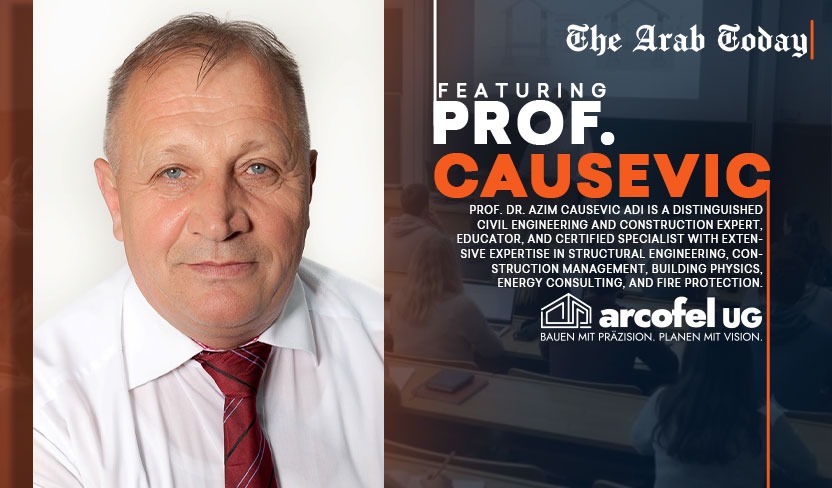
Prof. Dr. Azim Causevic represents a multidisciplinary approach to the construction and engineering sector, combining academic knowledge with extensive practical expertise in engineering, construction management, building physics, project management and independent expert assessment. Through his professional work, he has developed a perspective that places technical quality, prevention, sustainability and professional integrity at the center of successful construction.
His work as an expert also brings him into situations involving construction defects, property damage, technical disputes and the assessment of complex building-related issues. Experiences such as the 2021 flooding in the Ahr Valley have further strengthened his understanding of resilience and the importance of preparing buildings and infrastructure for changing environmental risks.
Alongside his practical activities, Prof. Dr. Causevic remains closely connected to academia and the development of future engineering professionals. His philosophy emphasizes the importance of combining theoretical knowledge with practical experience, interdisciplinary cooperation and a strong sense of professional responsibility.
The Importance of Planning Before Construction Begins
The Arab Today: “You work at the intersection of engineering, construction, project management, expert assessment and academia. When you look at a construction project today, what do you believe is most often overlooked during the planning stage?”
Dr. Causevic replied, “One of the biggest issues I see is that people sometimes focus too strongly on getting a project started and not enough on understanding the project properly before construction begins. Good planning is not bureaucracy. It is one of the most important forms of risk management.
A building is a complex system. Structural safety, building physics, materials, energy performance, costs, regulations, construction sequencing and future maintenance are all connected. If one of these aspects is ignored at the beginning, the consequences can appear much later, when correcting the problem is considerably more expensive.
I have always believed that prevention is better than correction. A well prepared project should anticipate potential technical difficulties instead of waiting for them to appear on the construction site.
Another important point is communication. Engineers, architects, contractors, owners and project managers may all look at the same project from different perspectives. If those perspectives are not brought together early, misunderstandings can develop into construction defects, delays or disputes.
My approach is therefore to look at the entire life cycle of a project. We should not ask only, ‘Can we build it?’ We should also ask, ‘Can we build it correctly, maintain it economically, operate it efficiently and ensure that it continues to perform as intended many years from now?’”
What Makes an Expert Assessment Truly Valuable
The Arab Today: “Your work as an expert often involves situations where something has already gone wrong, whether it is a construction defect, property damage or a dispute between different parties. What separates a strong expert assessment from simply describing a problem?”
Dr. Causevic replied, “A strong expert assessment must go beyond describing what can be seen. The visible defect is often only the symptom. The real professional task is to understand the cause.
For example, if moisture appears inside a building, simply documenting the moisture is not enough. We need to investigate where the water is coming from, how it entered the building, which construction components have been affected and whether the problem is related to planning, workmanship, materials, maintenance or external circumstances.
That requires systematic investigation and technical knowledge. Measurements, documentation, drawings, construction records, site observations and applicable technical standards can all be important.
Independence is equally important. An expert should not begin an investigation with the intention of proving that one particular party is right. The evidence should determine the conclusion.
I also believe that an expert report must be understandable. Technical expertise has little value if the reasoning cannot be followed by the people who need to use the report, including property owners, lawyers, insurers, courts or other professionals.
For me, the quality of an expert assessment is therefore based on three things: objective investigation, technically sound reasoning and clear communication. The conclusion should be something that another qualified professional can understand and evaluate based on the evidence presented.”
Learning from Extreme Events and Building Resilience
The Arab Today: “You have dealt with construction and property issues in the context of serious events such as the 2021 flooding in the Ahr Valley. How have such experiences changed the way you think about resilience in the built environment?”
Dr. Causevic replied, “Events such as the flooding in the Ahr Valley remind us that buildings do not exist in isolation. They are part of a larger environment, and that environment can change dramatically.
A building may perform perfectly under normal conditions but be exposed to circumstances that were not adequately considered during its planning or construction. Extreme weather events force us to reconsider what we mean by resilience.
Resilience does not mean that every building must be capable of withstanding every conceivable disaster. That would not be realistic. It means that we need to understand the risks in a particular location and make sensible decisions based on those risks.
Flood protection, drainage, structural considerations, material selection, electrical systems and the positioning of important building services can all influence how a building responds to extreme events.
There is also an important lesson concerning documentation. After a disaster, it becomes much easier to investigate the causes of damage when construction documents, maintenance records and previous inspections are available.
The experience has reinforced my belief that prevention, preparedness and technical knowledge have enormous value. We cannot control natural events, but we can improve the way we design, construct and maintain buildings so that their vulnerability is reduced.”
Making Sustainability Practical and Economically Responsible
The Arab Today: “The construction industry is under pressure to become more sustainable while also dealing with rising costs, skilled labour shortages and increasingly complex regulations. How can companies pursue sustainability without making construction unnecessarily complicated or expensive?”
Dr. Causevic replied, “Sustainability should not be treated as an additional layer that is simply placed on top of conventional construction. It should be integrated into the way we plan and evaluate projects.
The first question should always be whether a proposed solution makes technical and economic sense over its entire life cycle. A material may be inexpensive to purchase but expensive to maintain. Another solution may have a higher initial cost but significantly lower operating costs and a longer service life.
This is why life cycle thinking is so important.
Energy efficiency is another good example. We should not simply install technology because it is considered modern or sustainable. We should understand how the entire building performs. Building physics, insulation, ventilation, moisture management, airtightness and heating systems all interact.
I also believe that renovation deserves much more attention. Europe already has an enormous building stock. We cannot solve every environmental challenge by constructing new buildings. Improving existing buildings can often provide significant environmental and economic benefits when the work is properly planned.
At the same time, sustainability must remain practical. A solution that looks excellent on paper but cannot be implemented reliably by contractors or maintained by building owners is not necessarily a sustainable solution.
The best approach is to combine environmental responsibility with engineering discipline and economic realism. That is where sustainable construction becomes truly meaningful.”
Preparing the Next Generation of Construction Professionals
The Arab Today: “As an academic and an experienced construction professional, you have the opportunity to observe both the next generation of engineers and the realities of today’s industry. What advice would you give young professionals who want to build a long and respected career in construction?”
Dr. Causevic replied, “My first advice would be not to stop learning. Construction is changing continuously. Regulations change, materials change, technologies develop and the expectations placed on buildings continue to evolve.
But education should not remain purely theoretical. Young professionals should spend time understanding what actually happens on construction sites. They should speak with experienced craftsmen, engineers, project managers and contractors. There is enormous knowledge in practical experience.
At the same time, practical experience should be combined with strong technical fundamentals. Understanding structural principles, building physics, materials, project management and the relevant legal framework gives professionals a much stronger foundation for making decisions.
I would also encourage young engineers to develop the ability to communicate. A technically excellent professional who cannot explain a problem clearly may struggle to influence important decisions. Construction is fundamentally collaborative.
Perhaps most importantly, young professionals should protect their professional integrity. There will always be pressure involving deadlines, budgets and competing interests. But credibility is built over many years and can be damaged very quickly if technical judgment is compromised.
A successful career in construction is not only about how many projects you complete or how many titles you hold. It is about whether people can trust your knowledge, your judgment and your professional responsibility.
If young professionals combine curiosity, technical competence, practical experience and integrity, they will be well prepared not only for the construction industry of today, but also for the much more demanding built environment of tomorrow.”
For more information:
Sachverständigenbüro AC
ARCOFEL UG
Prof. Dr. Azim Causevic on LinkedIn
Also Read:-
Sandra Woodall: Designing Resilient, Sustainable Cities
Tsoline Gharibian on Commercial Law, AI, Tech and Privacy
Shaji N Nair: Building Qatar’s Landmarks with Excellence