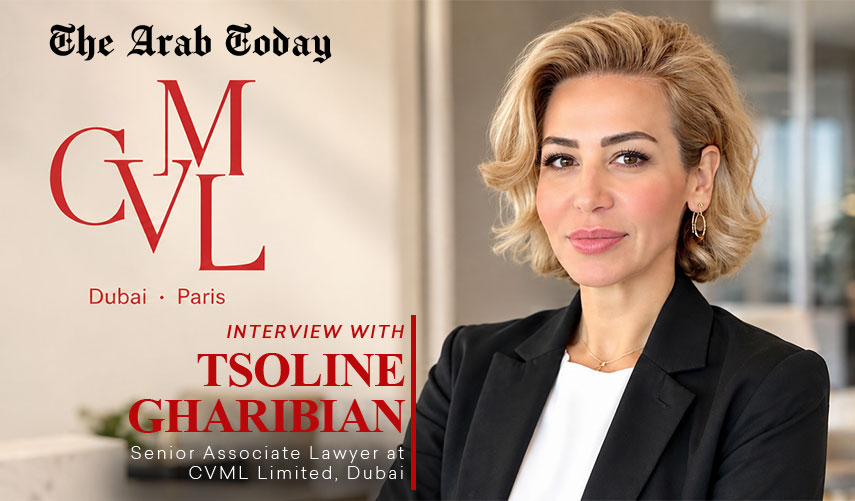
Tsoline Gharibian Interview
Tsoline Gharibian is a Senior Associate Lawyer, Commercial and Technology Contracts Specialist, and Data Protection Officer with more than 20 years of legal experience. Her practice sits at the intersection of commercial law, technology and regulation, with a particular focus on commercial and technology contracts, data protection, cybersecurity, AI governance, compliance, and legal risk management. Currently serving as Senior Associate Lawyer at CVML Limited Dubai, she advises businesses and multinational organizations on complex matters across commercial, technology, data protection and AI governance, with experience spanning multiple sectors and jurisdictions.
Her experience spans the GCC, MENA and EU markets, giving her a cross-border perspective on the legal and regulatory challenges created by rapidly evolving technology.
“We are moving from compliance as a checklist towards governance as infrastructure.”
Commercial Law to Technology Regulation
We started the interview by asking, “You have built a legal career spanning commercial law and technology regulatory matters. How has your practice evolved over the past two decades?”
Tsoline Gharibian replied, “I began my legal career in Lebanon, where I developed a strong foundation in commercial law, disputes, business risks and financial crime matters. Those early years taught me that the best lawyer is not simply the one who resolves a problem after it arises, but the one who identifies and manages the risk before it becomes a problem.
As my career progressed, I became increasingly interested in the relationship between law, technology and business. My work with multinational organizations between Lebanon and Cyprus, followed by my move to CVML Ltd. Dubai, gave me valuable exposure to cross-border transactions and different regulatory environments.
Over time, my practice evolved towards commercial and technology law, data protection, cybersecurity, AI governance and compliance. I also serve as a Data Protection Officer, which has further strengthened my understanding of how legal requirements need to translate into practical business processes.
Today, my practice sits at the intersection of business, technology and regulation, with a particular focus on helping organizations understand their legal risks while enabling them to operate, innovate and grow responsibly across the GCC, MENA and EU markets.”
Where Law, Technology and Business Meet
The Arab Today: What drew you to commercial and technology law, and how are emerging technologies and AI reshaping the role of the modern lawyer?
Tsoline Gharibian replied, “I have always been interested in the relationship between law and business. At the heart of every business relationship is a contract: it establishes the framework for the relationship, defines rights and responsibilities, allocates risk and provides the foundation for continuity.
At CVML Dubai, I work extensively with commercial and technology contracts, including sales, partnerships, distribution and services agreements, as well as internal policies and compliance. What makes this area particularly dynamic is that the legal framework constantly evolves alongside the technology and business models it supports.
Today, technology contracts can involve much more than traditional commercial terms. They may raise questions around data protection, cybersecurity, intellectual property, regulatory compliance and liability.
The modern technology lawyer therefore has to understand three things simultaneously: the law, the technology and the business objective. That combination is what this field particularly challenging and particularly rewarding.”
A Career Guided by Practical Thinking
The Arab Today: After such extensive experience, what principle has guided you throughout your legal career?
Tsoline Gharibian replied, “Never look at the law in isolation from the reality it is supposed to serve. A lawyer can identify a legal risk, but the real value comes from understanding why that risk matters to the business, what it means operationally, and how it can be managed without unnecessarily preventing progress.
I don’t believe the role of a lawyer is simply to say “no//cannot be done.” It is to say: here is the risk, here is why it matters, and here is how we can move forward responsibly.
That is the approach I have developed. I try to understand not only the legal issue, but also the commercial objectives, the business model and the practical realities behind it.
Today, as technology and regulation evolve so quickly, that approach has become even more important. Businesses need legal advice that protects them but also gives them the confidence and clarity to move forward.”
Managing Legal Risks
The Arab Today: Before signing an AI or technology-related contract, what should businesses consider, and how should they manage the associated legal and commercial risks?
Tsoline Gharibian replied, “Businesses should look beyond the wording of a contract and first understand the commercial, financial, data, cybersecurity and regulatory risks involved.
For an AI or technology contract, I would ask: What data is being processed? Where is it stored? Can it be used to train AI models? Who owns the outputs? What happens if the AI produces an inaccurate or harmful result? And, most importantly, who bears responsibility? Therefore, the contract should address not only the commercial terms, but also data protection, cybersecurity, intellectual property, confidentiality, liability, human oversight and accountability.
Today, companies use AI-enabled tools and software, including CRM systems, to process employee, customer and other business data. These technologies can create additional legal exposure that needs to be considered.
Innovation is moving extremely fast, particularly with AI. AI tools have made legal and business work significantly faster and more efficient, but businesses should not simply rely on contracts generated by AI tools without professional legal review.
AI can assist the lawyer, but legal responsibility cannot simply be outsourced to a machine. Human judgment, reasoning and accountability remain essential.
My approach is therefore to use technology to enhance legal work while applying human experience and legal judgment to identify risks before they become problems.”
Building Effective AI Governance
The Arab Today: AI governance has become one of the most discussed topics in business. What does it mean in practice?
Tsoline Gharibian replied, “AI governance is essentially the framework through which an organization determines how AI is selected, developed, deployed, monitored and controlled.
In practice, it means establishing clear policies, responsibilities and accountability around the use of AI within the business.
From the legal perspective, an important part is data governance—ensuring that the organization has appropriate rules around data ownership, classification, access, retention and lawful use. Therefore, AI governance is not exclusively an IT issue. It involves legal, compliance, cybersecurity, HR, risk management and senior leadership.
Governance should not be viewed as the brake on innovation. Done properly, it is the infrastructure that allows innovation to scale safely.
AI can create enormous opportunities, but organizations need governance structures that allow them to innovate while maintaining legal, ethical, operational and reputational control.”
A Multidisciplinary Approach
The Arab Today: How has your experience across different legal areas shaped your approach to technology and emerging risks?
Tsoline Gharibian replied, “A multidisciplinary perspective is particularly valuable because technology has blurred the boundaries between traditional areas of law.
AI and technology projects often span multiple legal areas, including contracts, data protection, cybersecurity, IP, employment and regulatory compliance. My experience has also given me a practical understanding of how agreements operate and, importantly, where and how disputes should be brought when things go wrong..
For example, the DIFC Courts have established a specialized Digital Economy Court to address sophisticated national and transnational civil and commercial disputes relating to current and emerging technologies, including AI, blockchain, big data, fintech, cloud services, robotics, 3D printing and unmanned aerial vehicles.
However, the Federal Authority for Artificial Intelligence and Data in the UAE, established in June 2026, is the national body that unifies federal AI and data policy, to guide compliance and propose future legislation.
This reflects how technology is not only changing the contracts we draft, but also where disputes are brought in and how they are resolved.”
Cybersecurity as a Legal and Business Priority
The Arab Today: How important is Cybersecurity in this new legal environment?
Tsoline Gharibian replied, “Cybersecurity is no longer simply an IT issue; it is also a legal, commercial and personal-rights issue. A data breach or a hacked account can have serious consequences for an individual, from loss of privacy to financial or reputational harm.
In the UAE, individuals are protected by a legal framework that includes the Federal Decree-Law No. 45 of 2021 Concerning the Protection of Personal Data and the Federal Decree-Law No. 34 of 2021 on Countering Rumors and Cybercrimes. These frameworks address different aspects of digital protection: data protection focuses on the lawful processing, privacy and protection of personal data, while the cybercrime legislation addresses unlawful conduct involving information technology, networks and digital platforms.
Where personal data is unlawfully accessed or a digital account is compromised, the appropriate legal response will depend on the circumstances, including the nature of the incident, the parties involved and the applicable legislation. Individuals may have avenues to report cyber incidents and, where applicable, pursue legal remedies.
The broader point is that these laws are not merely about regulating businesses; they are also about protecting privacy, personal rights and trust in the digital environment. The law is there not only to regulate businesses, but also to protect the rights and privacy of individuals. For businesses, this is why cybersecurity and data governance must be treated as part of overall legal and commercial risk, not simply as an IT function.
Cybersecurity is ultimately about trust. Once trust is compromised, the consequences can extend far beyond the technical incident itself.”
Assessing GCC Readiness
The Arab Today: Are businesses in the GCC ready for the new generation of AI and data regulation?
Tsoline Gharibian replied, “I believe the GCC has made significant progress in developing AI, data privacy laws and digital regulatory frameworks, particularly in the UAE, KSA and other GCC countries, and this development is continuing across the region.
But readiness is not simply about having legislation. It is about implementation. A company can have policies sitting in a document, but the real test is whether those principles are embedded in contracts, systems, procurement, employee practices, cybersecurity controls and decision-making.
The next phase, in my view, will therefore be moving from regulatory awareness to genuine governance maturity. That’s where organizations will distinguish between simply having compliance documents and actually having a functioning governance culture.”
The Next Legal Challenge
The Arab Today: Looking ahead, what do you believe will be the defining legal challenge for the next generation of businesses?
Tsoline Gharibian replied, “I think it will be the ability to innovate quickly while maintaining trust. The next generation of businesses will be built around data, AI, digital platforms, automation and increasingly sophisticated technologies.
The challenge will not simply be whether technology works. It will be whether customers trust it, whether employees understand it, whether regulators can oversee it, whether investors are comfortable with its risks and whether the organization can demonstrate accountability.
That is why I believe AI governance, data protection and cybersecurity will move from being specialist compliance topics to becoming fundamental elements of corporate strategy.”
Building practical bridges
The Arab Today: What do you hope to contribute to the future of commercial and technology law, particularly across the GCC, MENA and Europe?
Tsoline Gharibian replied, “I hope to continue contributing to a legal environment where businesses can innovate while understanding and managing their legal responsibilities.
Commercial law, technology, cybersecurity, data privacy and AI governance are becoming increasingly interconnected. Lawyers therefore need to understand not only traditional legal principles, but also how businesses operate, how technology works and how regulation translates into practice.
I am particularly interested in the space between the GCC, wider MENA and Europe, where businesses, technology companies and investors increasingly operate across borders.
There is an enormous opportunity to build stronger bridges between different regulatory environments while allowing innovation to flourish.
My goal is to contribute to a more practical approach to AI governance, data protection and technology contracts-one that protects individuals and organizations while allowing businesses to innovate and scale responsibly.”
Advice for CEOs and Founders Entering the AI Economy
Lastly we asked, “What is the one piece of advice you would give CEOs and founders entering the AI economy?”
“Do not ask only what AI can do for your business; ask what your business needs to become in order to use AI responsibly”.
The companies that succeed will not necessarily be those that adopt AI the fastest. They will be those that combine AI adoption with trusted data, cybersecurity, human oversight, accountability and sound governance.
AI adoption without governance can create speed. AI adoption with governance can create sustainable value. And that, ultimately, is the direction I believe modern businesses should be pursuing innovation with responsibility, speed with judgment, and technology built on trust.” Tsoline Gharibian concluded
Connect with Tsoline Gharibian on LinkedIn & t.gharibian@cvml.ae
For more information visit CVML Limited
Also Read:-
Shaji N Nair: Building Qatar’s Landmarks with Excellence
Mohammad Mousa: Driving Government & Business Transformation
Dr. Sandeep Vision for Saudi Arabia’s Business Future