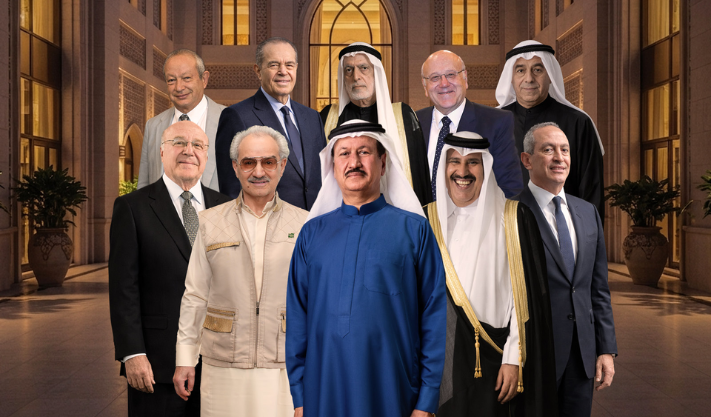
Over the past decade, Hussain Sajwani has emerged as the dominant force among Arab billionaires, increasing his wealth by around $12.1 billion to reach approximately $15.3 billion as of early March 2026. His remarkable rise highlights the success of well-timed investments in real estate and hospitality, securing his position as the biggest gainer among the region’s 10 richest individuals.
Following him is Egypt’s Nassef Sawiris, whose fortune grew by $5.9 billion over the same period, largely supported by his interests in construction and industrial ventures. Qatar’s Hamad bin Jassim bin Jaber Al Thani also posted strong gains, adding roughly $4 billion through finance and global investments.
In contrast, the only decline within the top 10 was recorded by Abdulla bin Ahmad Al Ghurair and his family, whose net worth slipped by about $400 million to $4.5 billion—a relatively modest drop compared to the broader upward trend.
Altogether, the combined wealth of the 10 richest Arab billionaires has climbed by nearly $32.6 billion over the past decade, reaching about $76.5 billion in Forbes’ 2026 World’s Billionaires rankings, based on stock prices and exchange rates as of early March. Notably, Saudi healthcare magnate Sulaiman Al Habib is not included in this comparison, as he only entered the global billionaire list in 2025.
These shifts underline a decade defined by significant wealth creation across the Arab world—led by standout performers and shaped by strategic sectoral bets.
Table of Contents
Toggle1. Hussain Sajwani
Change since 2016: $12.1 billion ↑
Net worth: $15.3 billion
Country: UAE
Sajwani first entered the billionaire ranks in 2016 with an estimated fortune of $3.2 billion. Over the past decade, he has added around $12.1 billion to his wealth—an increase of roughly 378%—bringing his net worth to about $15.3 billion on the 2026 global billionaire rankings. This makes him the biggest gainer among the 10 richest Arab billionaires over the last ten years. He now stands as the second-richest Arab, behind Saudi Prince Alwaleed bin Talal Al Saud, whose fortune is estimated at $19.9 billion, and ranks among the top 200 billionaires worldwide.
Sajwani is the chairman of DAMAC Properties, the Dubai-based real estate developer he founded in 2002. In 2025, the company reported sales of approximately $9.8 billion (AED 36 billion). Since its launch, DAMAC has delivered around 50,000 residential units, with more than 54,000 additional units currently under development.
His rapid rise is closely tied to the strength of Dubai’s real estate market, particularly in the years following the pandemic. A surge in demand from high-net-worth individuals, global investors, and new capital inflows significantly boosted property values and transaction activity. This environment played a major role in accelerating the wealth of developers with strong exposure to premium real estate, positioning Sajwani as one of the standout beneficiaries of the sector’s growth.
2. Nassef Sawiris
Change since 2016: $5.9 billion ↑
Net worth: $9.6 billion
Country: Egypt
Sawiris, a member of Egypt’s wealthiest family, has grown his fortune by about $5.9 billion—an increase of roughly 159.5%—over the past decade, reaching an estimated $9.6 billion as of early March 2026. This strong performance, fueled by a series of strategic investments and diversified business ventures, makes him the second-biggest gainer among the top 10 Arab billionaires during this period.
In 2018, he teamed up with businessman Wes Edens, co-founder of Fortress Investment Group, to acquire English Premier League club Aston Villa. He further expanded his global investment footprint in 2020 by purchasing a 5% stake in Madison Square Garden Sports, which owns the New York Knicks and New York Rangers.
He currently serves as executive chairman of OCI Global, one of the world’s leading nitrogen fertilizer producers, with manufacturing operations in Texas and Iowa and shares listed in Amsterdam. While he plans to step down from his executive role, he is expected to remain involved as a non-executive board member. He is also set to become chairman of Adidas in May 2026, where he holds an approximate 6% stake.
In addition, his engineering and construction company, Orascom Construction, is listed on both the Egyptian and Abu Dhabi stock exchanges. In 2024, ADNOC acquired OCI’s stake in Fertiglobe for $3.62 billion, marking another major milestone within his business portfolio.
3. Hamad bin Jassim bin Jaber Al Thani
Change since 2016: $4 billion ↑
Net worth: $5.2 billion
Country: Qatar
Al Thani’s fortune has risen sharply over the past decade, increasing by about 333.3%, or $4 billion, to reach an estimated $5.2 billion as of early March 2026. This growth has been largely driven by his strong presence in financial services and global investments, including a significant 4.5% stake in Deutsche Bank through Paramount Services Holdings, which remains his largest publicly known asset.
He first entered the billionaire ranks in April 2016, when his net worth was estimated at $1.2 billion. According to the 2026 global billionaire rankings, he is now among the top Arab billionaires and holds a position within the world’s wealthiest individuals.
Beyond business, Al Thani has had a notable political career, serving as Qatar’s prime minister from 2007 to 2013 and as foreign minister from 1992 to 2013. A member of the country’s ruling family, he is closely related to the current emir, while his elder uncle is recognized for founding modern Qatar in 1971.
4. Prince Alwaleed Bin Talal Alsaud
Change since 2016: $2.6 billion
Net worth: $19.9 billion
Country: Saudi Arabia
Over the past decade, Prince Alwaleed bin Talal’s net worth has grown by around $2.6 billion, reaching approximately $19.9 billion. This increase has been supported by the post-pandemic rebound in global markets, which lifted the value of his international investments, particularly in technology and hospitality. Portfolio optimization within Kingdom Holding Company has also played a role, channeling capital toward higher-performing assets and improving overall returns. In addition, the global stock market recovery and rising valuations of companies in which he holds stakes have further strengthened his wealth, while Saudi Arabia’s economic reforms and a more favorable investment climate have boosted the value of his domestic holdings.
Recent estimates from Kingdom Holding Company suggest that the value of his private office investments in ventures linked to Elon Musk—including SpaceX, X, xAI, and Starlink—has climbed to about $9.2 billion, compared with roughly $130 million invested in X back in 2011.
5.Naguib Sawiris
Change since 2016: $2.6 billion
Net worth: $5.6 billion
Country: Egypt
Sawiris’ wealth has increased by about $2.6 billion over the past decade, reaching an estimated $5.6 billion as of March 1, 2026, largely supported by rising gold prices and his long-standing investments in the precious metals sector.
He serves as executive chairman of Orascom Investment Holding and built much of his fortune through telecom investments, particularly via Orascom Telecom Holding, which merged with VimpelCom in 2011.
In addition, he chairs the Investment Advisory Committee of La Mancha Resource Capital, an investment firm focused on precious metals and energy transition resources, with stakes in several global mining and resource companies. He is also chairman of Ora Developers, which focuses on luxury real estate and hospitality projects.
6. Abdulla Al Futtaim & family
Change since 2016: $1.7 billion
Net worth: $4.8 billion
Country: UAE
Since 2016, the wealth of Abdullah Al Futtaim and his family has increased by about $1.7 billion, reaching an estimated $4.8 billion as of early March 2026, supported by solid business performance and continued regional expansion. He owns the Al-Futtaim Group, which is now led by his son Omar, serving as vice chairman and CEO.
Established in 1955, the group remains the exclusive distributor of Toyota in the UAE. It also operates the UAE franchises for major international brands including IKEA, Hertz, Toys “R” Us, and Marks & Spencer. These brands form the core of its retail operations, alongside prominent shopping destinations such as Dubai Festival City, Dubai Festival Plaza, Doha Festival City, and Cairo Festival City.
7. Mohamed Mansour
Change since 2016: $1.5 billion
Net worth: $ 4 billion
Country: Egypt
Mansour’s fortune has increased by about $1.5 billion over the past decade, reaching approximately $4 billion. He leads the family-owned Mansour Group, established by his father, Loutfy Mansour, in 1952, which now employs around 60,000 people. In 1975, he launched Egypt’s General Motors dealerships, building the operation into one of the largest GM distribution networks globally. The group also holds exclusive rights to distribute Caterpillar equipment in Egypt and several other African markets.
Alongside his Egyptian citizenship, Mansour holds British nationality. He served as Egypt’s transport minister from 2006 to 2009 during the presidency of Hosni Mubarak. Today, his son, Loutfy Mansour, heads the group’s direct investment division, Man Capital.
8. Najib Mikati
Change since 2016: $1.3 billion
Net worth: $3.8 billion
Country: Lebanon
Over the past decade, Mikati’s fortune has increased by about $1.3 billion. The former Lebanese prime minister is also co-founder of the investment firm M1 Group. During this period, he served as Lebanon’s prime minister from September 2021 to February 2025, in addition to earlier terms between 2011 and 2014 and a brief tenure in 2005.
Alongside his political career, Mikati has built a long-standing business legacy. In 1982, he and his brother Taha founded Investcom, initially selling satellite phones during the Lebanese civil war. The company later expanded across Africa, developing telecom infrastructure in countries such as Ghana, Liberia, and Benin. Investcom went public on the London and Dubai stock exchanges in 2005 before merging with telecom giant MTN in 2006. A year later, the brothers established M1 Group, which grew into a diversified investment conglomerate. As of December 2025, M1 Limited held a 5.94% stake in MTN.
9.Taha Mikati
Change since 2016: $1.3 billion
Net worth: $3.8 billion
Country: Lebanon
As of early March 2026, Mikati’s net worth was estimated at $3.8 billion, marking an increase of about $1.3 billion over the past decade. His investment portfolio includes stakes in telecom operator MTN, fashion brand Baby Jeans, and high-end real estate across cities such as New York, London, and Monaco. His son, Azmi Mikati, currently serves as CEO of M1 Group.
Over the same period, MTN has shown a strong turnaround, moving from losses in 2016 to reporting a net income of $1.7 billion (Rand 27.4 billion) in 2025, mirroring the growth in the Mikati family’s wealth.
Mikati began his entrepreneurial journey in the early 1980s by purchasing satellite phones and reselling them in Beirut. He later expanded the business with his brother, building telecom infrastructure across several African countries, including Ghana, Liberia, and Benin.
10. Abdulla bin Ahmad Al Ghurair & family
Change since 2016: $400 million
Net worth: $4.5 billion
Country: UAE
Al Ghurair stands out as the only billionaire in the group to record a decline in wealth, with his net worth falling by about 8.2%—roughly $400 million—to $4.5 billion as of early March 2026. However, such a decrease does not necessarily signal weakness. It may instead reflect differences in asset allocation, limited exposure to the sectors that experienced the strongest gains, or long-term capital deployment decisions. Wealth tied to industries that once drove growth can plateau if investments are not redirected toward emerging opportunities. In some cases, factors such as philanthropy, privately held assets, or valuation changes that are not immediately visible can also influence reported net worth.
Despite this dip, the broader trend remains positive. Nine of the top 10 Arab billionaires have recorded gains over the past decade, highlighting the overall resilience of wealth in the region. Fortunes built on diversified businesses, strategic investments, and sectors benefiting from both regional reforms and global market conditions have continued to grow steadily, underscoring the importance of positioning and sector exposure in long-term wealth creation.
Also Read:-
The Middle East’s Healthcare Billionaires in 2026
Saudi Arabia’s PIF Eyes $5B Stake in SpaceX IPO
Fiscal Discipline Drives Oman’s Resilience