Shir Sagie Interview
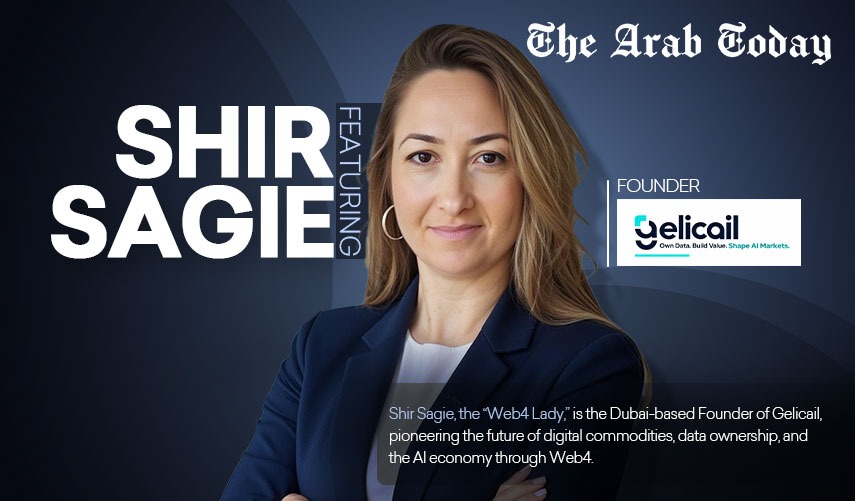
Shir Sagie is the Dubai-based founder of Gelicail, a company developing commercial products and marketplace infrastructure for digital commodities on Web4. Known in her professional circles as the “Web4 Lady,” Sagie is advancing a new economic vision centred on data ownership, digital commodities, and economic participation in the age of artificial intelligence.
Artificial intelligence is transforming industries, governments, and economies at unprecedented speed. Yet behind every AI system lies a resource whose economic significance is only beginning to be understood: data.
For Sagie, this represents one of the defining economic questions of our time. As AI becomes an increasingly powerful consumer of data, who owns that data? Who controls its use? And who benefits from the economic value it generates?
Based in Dubai, she is building Gelicail around the commercial opportunities emerging from Web4, an open-source technological architecture that could support new forms of digital ownership, interoperability, and economic exchange.
We spoke with Shir Sagie about the future of the AI economy, why data should be treated as a commodity, Dubai’s role in the next economic transformation, and how Gelicail is beginning to turn this vision into commercial products.
The Vision Behind the “Web4 Lady”
We started the interview by asking, “Shir Sagie, you have become known as the ‘Web4 Lady.’ Where did that name come from, and what is the vision behind it?”
Sagie: I think the name reflects how passionately I talk about Web4 and its economic potential.
But my interest in Web4 has never been limited to technology. What fascinates me is the possibility of creating an entirely new economic architecture.
For more than three decades, the internet has transformed the way we communicate, work, consume, and conduct business. It has generated extraordinary wealth, but much of that wealth has accumulated within a relatively small number of digital platforms.
Now artificial intelligence is accelerating another transformation.
AI is creating enormous demand for data, yet the economic structures governing the ownership and commercialisation of that data have not evolved at the same pace.
I believe Web4 offers an opportunity to address this imbalance.
My mission with Gelicail is to help build the commercial layer of this emerging architecture, enabling businesses, governments, and eventually individuals to participate directly in the economic value created from their data.
That is what the Web4 Lady represents to me: a commitment to making the next generation of the internet economically meaningful.”
Understanding Web4 and the Next Generation of the Internet
The Arab Today: What exactly is Web4, and how is it different from the internet we use today?
Sagie: Today’s internet is largely built around centralised platforms and databases.
Organisations collect data, store it in their systems, and exchange it through integrations, interfaces, and contractual arrangements. The data itself is frequently separated from the people or organisations that originally generated it.
Web4 introduces a fundamentally different architectural approach.
It is based on the concept of interoperable digital objects that can operate across environments while maintaining relationships with their identities, ownership information, and governing rules.
Instead of thinking primarily in terms of isolated applications and databases, we can begin thinking about an ecosystem of connected objects capable of interacting and participating in economic transactions.
This is particularly important in the age of AI.
AI agents will increasingly interact with systems, services, organisations, and one another. They will need access to reliable data, but they will also need mechanisms to establish permissions, ownership, and commercial conditions.
Web4 has the potential to provide the architectural foundation for these interactions.
I see it not simply as the next generation of internet technology, but as a foundation for the next generation of digital economic activity.”
Data as a Commodity: Unlocking a New Economic Opportunity
The Arab Today: You frequently use the expression “Data as a Commodity.” Why is this concept so important?
Sagie: Because I believe we are witnessing a fundamental change in the economic role of data.
Historically, data was treated primarily as information, something organisations collected to improve operations, understand customers, or make decisions.
Today, data has become an essential raw material for artificial intelligence.
Just as energy powers industrial production, data powers the development, training, and operation of AI systems.
And like other raw materials, data has different qualities, levels of scarcity, commercial applications, and economic value.
However, there is a major difference.
We have well-established economic structures for trading oil, electricity, metals, and agricultural commodities. We understand ownership, pricing, distribution, and the participation of different stakeholders in those markets.
Data does not yet have an equivalent universal economic framework.
Much of its value is captured through platform control, exclusive access, or bilateral commercial agreements.
I believe this needs to change.
Data as a Commodity means recognising data as an economically valuable resource that can be governed, priced, and traded under defined ownership and usage conditions.
The challenge is not simply to sell more data. It is to create an architecture in which the value generated from data can be attributed, exchanged, and accumulated by the appropriate economic participants.
That distinction is central to everything we are building at Gelicail.”
The Emerging AI Economy and Economic Participation
The Arab Today: How does this connect to the emerging AI economy?
Sagie: I often say that becoming AI-native is not simply about adopting artificial intelligence. It is about becoming part of the new economy AI creates.
Today, most discussions about AI transformation focus on productivity.
Companies want to automate processes, reduce costs, improve customer service, and make better decisions.
These are important benefits, but they represent only one side of the transformation.
The other side is economic participation.
As AI becomes embedded in almost every industry, enormous new markets will emerge around the data, services, intelligence, and transactions that AI systems consume and generate.
The question is: who will participate in these markets?
Will businesses and governments remain primarily consumers of AI technologies developed by others? Or will they also become suppliers of valuable resources to the AI economy?
For me, this is one of the most important strategic questions facing organisations today.
Gelicail is focused on helping them move from being passive data providers or technology consumers to becoming active participants in the AI economy.
This means identifying valuable data, establishing the conditions under which it can be commercialised, and creating products that generate new revenue streams.
Ultimately, I believe the AI economy will require much more than powerful models and computing infrastructure.
It will require an economic architecture for the resources those systems depend on.”
Building Gelicail: From Data to Digital Commodities
The Arab Today: What is Gelicail building, and how is it different from existing data marketplaces?
Sagie: Gelicail is building products and commercial infrastructure for the emerging economy of digital commodities on Web4.
The distinction from traditional data marketplaces is fundamental.
Existing marketplaces generally help organisations distribute, share, license, or monetise datasets through established cloud and data infrastructure.
These services play an important role, but they typically operate within the existing internet architecture.
Our vision begins at a different point.
We want to make it possible to identify valuable data within existing environments and transform it into digital commodities.”
The Importance of Digital Ownership and Value Accumulation
The Arab Today: Why is ownership such an important part of your vision?
Sagie: Because without ownership, it is very difficult to create a sustainable economy around a resource.
Think about traditional industries.
A company that owns a valuable resource can decide how to use it, whom to sell it to, and under what commercial conditions.
In today’s digital economy, these relationships are often much less clear.
Data may originate from individuals, businesses, devices, or physical activities, but once it enters a centralised platform, the original source may have limited visibility or control over how value is created from it.
This creates what I describe as value leakage.
Economic value is generated, but it does not necessarily accumulate where the resource originated.
I believe the next generation of digital infrastructure should make it possible to preserve the connection between data, ownership, rights, and economic activity.
Of course, technology alone cannot establish legal ownership. Rights must be defined through appropriate legal and commercial frameworks.
But architecture can make those relationships more transparent, traceable, and enforceable.
This is why our approach is not simply about monetisation.
It is about value accumulation instead of value leakage.
For businesses, that could mean new recurring revenue streams.
For governments, it could mean greater economic participation in the value generated from national data resources.
And for individuals, it could eventually create new ways to benefit economically from data they generate or have rights to.”
Reimagining the Hospitality Industry Through AI and Web4
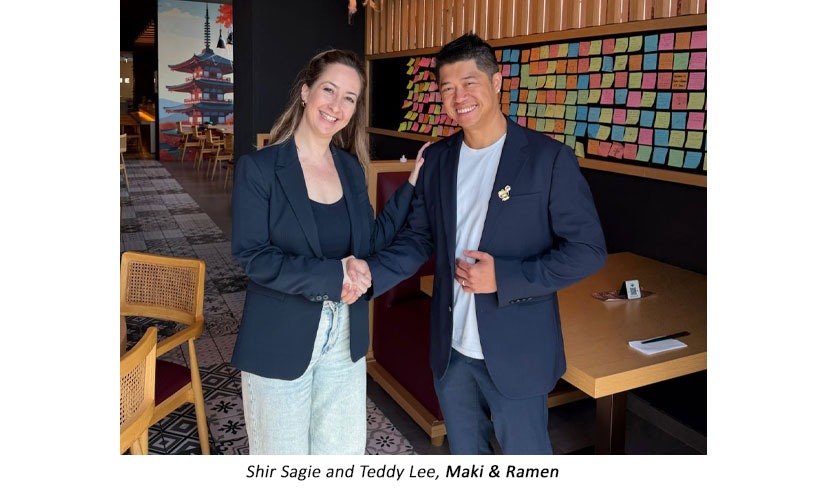
The Arab Today: Gelicail has begun collaborating with Maki & Ramen. Tell us about this partnership.
Sagie: Maki & Ramen is a successful UK restaurant chain that has recently expanded internationally with its first location in Dubai.
What makes this collaboration particularly exciting is the opportunity to work with its remarkable founder, Teddy Lee, a rising star in the international culinary scene and an Ernst & Young Entrepreneur of the Year nominee.
Maki & Ramen has built a strong following among Generation Z consumers in the UK, making it a particularly exciting partner for exploring the future of hospitality.
Generation Z is growing up in a world shaped by artificial intelligence, digital experiences, and entirely new expectations of how businesses should operate.
For me, this makes Maki & Ramen an ideal partner to take the conversation one step further.
Rather than asking only how technology can improve today’s restaurants, we are asking a much more exciting question:
What will a restaurant look like ten years from now, when the AI economy has become part of everyday life?
I believe the answer will go far beyond automation, digital ordering, or personalised recommendations.
We are talking about reimagining how restaurants participate in the digital economy, how they interact with customers and other businesses, and how new forms of economic value can emerge.
Working with Teddy and Maki & Ramen gives us an opportunity to explore that future alongside a brand that already understands the next generation of consumers.”
Teddy Lee: Entrepreneurial Thinking and the Future of Business
The Arab Today: What role has Teddy Lee played in this journey?
Sagie: What I particularly appreciate about Teddy is his willingness to look beyond the immediate needs of an existing business.
Many business leaders approach new technology by asking how it can make their current operations more efficient.
That is a legitimate question, but Teddy has been open to exploring something much broader: how a business can position itself within an entirely new economic environment.
That kind of entrepreneurial curiosity is extremely valuable.
Teddy combines the ambition of a successful hospitality entrepreneur with the willingness to challenge conventional thinking about the future of his industry.
I believe that combination is precisely what makes collaborations like ours so interesting.
The future of the AI economy will not be shaped by technology companies alone. It will also be shaped by visionary entrepreneurs who understand their industries and are willing to imagine what those industries could become.”
Why Dubai Is the Ideal Base for Gelicail
The Arab Today: Why did you choose Dubai as the base for Gelicail’s activities?
Sagie: Dubai is a particularly interesting place to build a company focused on the future of the digital economy.
It combines an international business environment, a strong culture of entrepreneurship, and a clear ambition to lead in emerging technologies.
But what interests me most is the city’s relationship with economic transformation.
Dubai has repeatedly demonstrated an ability to develop new industries, attract global participants, and position itself as a hub for international trade.
I believe the next major opportunity lies in the trade of digital commodities.
As artificial intelligence transforms global economic activity, cities and countries that understand the commercial value of data may have an opportunity to establish entirely new markets.
Dubai already has a strong foundation in international commerce, logistics, finance, and technology.
The possibility of extending that commercial mindset into the AI economy is extremely compelling.
For Gelicail, Dubai provides an environment in which we can engage with businesses, investors, policymakers, and international stakeholders from many different industries.
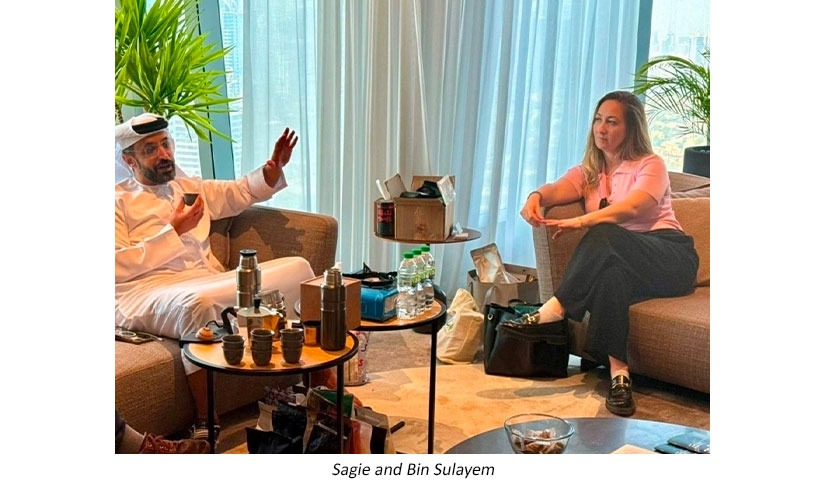
One of the people who, to me, best embodies Dubai’s identity as a global trading hub is Ahmed Bin Sulayem, Chairman of DMCC. I’ve had many fascinating conversations with Ahmed about the next evolution of the web and what the AI economy might look like. We even hold roundtable discussions on these pressing topics, bringing together key figures from the global economy to explore the opportunities and challenges ahead.
An ecosystem led by forward-thinking individuals like Ahmed, who are willing to challenge conventional thinking, is exactly where a new economic paradigm can emerge.
And really, what could be more natural than Dubai leading the global economy of Digital commodities? Trade is deeply rooted in Emirati heritage.
Our ambition is global, but Dubai is an excellent place from which to build the relationships and commercial ecosystem needed to pursue it.”
Data as a National Economic Resource
The Arab Today: Do you believe governments will eventually treat data as a national economic resource?
Sagie: Absolutely. I believe this is a discussion that governments will increasingly need to have.
Countries have long understood the economic importance of natural resources, industrial capacity, infrastructure, and human capital.
But data is becoming an equally important consideration in the development of the AI economy.
Every country generates enormous amounts of potentially valuable data through economic activity, public services, transportation, energy, healthcare, and other sectors.
The question is how that value is governed and how the benefits are distributed.
Today, much of the economic value generated from data may be realised by technology providers or platforms operating outside the country where the data originated.
That does not mean countries should restrict the flow of data or prevent international innovation.
Quite the opposite.
I believe we need architectures that make cross-border economic participation easier while preserving legitimate rights and commercial interests.
If countries can establish appropriate frameworks for ownership, access, and commercialisation, they could create new opportunities for domestic businesses and individuals to participate in the global AI economy.
Over time, this could also influence how we think about national economic output and the contribution of data-intensive industries.
Data should not automatically be counted as additional GDP simply because it exists. Its measurable economic contribution depends on the value actually produced.
But I believe governments should begin treating data as a strategic economic resource rather than merely an administrative or technological byproduct.”
The Challenges of Building a Global Digital Commodities Marketplace
The Arab Today: What are the biggest challenges in creating a global marketplace for digital commodities?
Sagie: The first challenge is changing how people think.
For decades, organisations have been taught to collect and protect data primarily as an internal business resource.
We are introducing a different perspective: data can also become the foundation for new products, commercial relationships, and revenue streams.
The second challenge is establishing trust.
For digital commodities to become widely traded, participants need confidence in the rights associated with them, the conditions governing their use, and the reliability of transactions.
The third challenge is building a shared understanding of the economic potential.
We are talking about a transformation that goes beyond technology. It requires businesses, governments, and individuals to rethink how value is created, exchanged, and accumulated in the digital world.
And as with any major economic transformation, that takes time, collaboration, and a willingness to challenge established assumptions.”
Shaping the Future of Gelicail and the Web4 Economy
The Arab Today: Looking ahead, what would success look like for Gelicail and for the Web4 economy?
Sagie: Success would mean that ownership and economic participation become natural parts of digital architecture.
Imagine a world in which a business does not need to surrender control over valuable data simply to participate in a digital ecosystem.
Imagine AI agents that can discover, request, and commercially access digital commodities under clearly defined conditions.
Imagine governments and individuals having new opportunities to participate in the economic value generated from the resources they contribute.
And imagine these transactions taking place across industries and borders, without every participant needing to operate within the same centralised platform.
That is the direction I believe the internet needs to evolve toward.
For Gelicail, our goal is to help turn that vision into commercial reality, one product, one industry, and one strategic partnership at a time.
We are still at the beginning of this journey, and there is a great deal of work ahead.
But I believe the next major economic transformation will not be defined only by who develops the most powerful artificial intelligence.
It will also be defined by who owns, supplies, governs, and trades the resources that intelligence depends on.
AI is creating a new economy. Data is its essential raw material. Web4 can provide the architecture for ownership, trade, and value accumulation.
And that is the economy we are building toward.”
About Shir Sagie
Shir Sagie is the Dubai-based founder of Gelicail, a company developing commercial products and marketplace infrastructure for digital commodities on Web4. Known as the Web4 Lady, she advocates for new economic models that enable businesses, governments, and individuals to participate in the AI economy through data ownership, commercialisation, and value accumulation.
Gelicail | Building the AI Economy on Web4.
Connect with Shir Sagie on LinkedIn
For more information, visit Gelicail
Also Read:-
Preba Moodley on Global Commodity Trade and Luxury Finance
Lars Mourey on Shower Filtration and Water Softening
Benjamin Miekisiak on Leadership, Clarity and Judgement