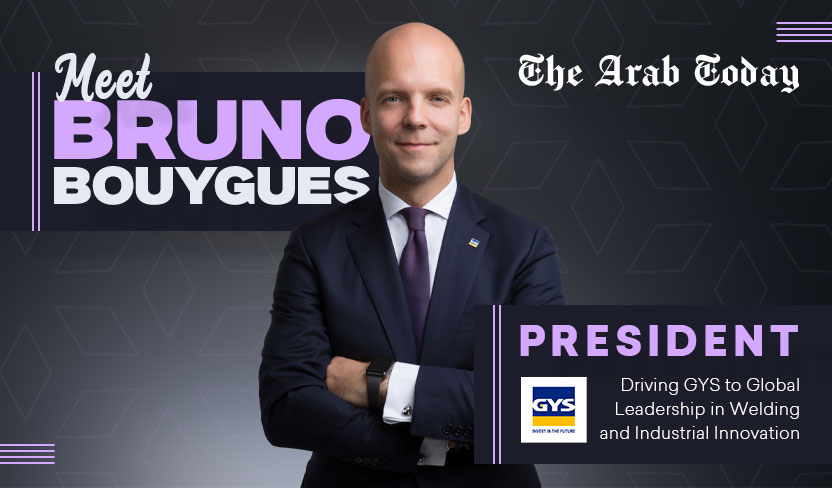
Bruno Bouygues Interview
Around the world, industry is undergoing a silent, invisible yet decisive transformation: machines are becoming more and more software driven. Under pressure from demands for productivity, traceability, and decarbonation, pure mechanics are simply no longer enough. Every welding station, charger, cobot and robot now runs on millions of lines of code. At Laval, the French company GYS embodies this revolution. What were once purely electromechanical devices now function as computers: they calculate, converse, self-diagnose, and receive updates. This shift impacts not only the nature of products, but also the bedrock of the company industrial expertise.
From Mechanics to Programming
For decades, industrial strength was measured by physical production capacity. Today, value increasingly resides in embedded intelligence: over 60% of a machine’s technological content comes from electronics and software. At GYS, a single welding machine may now contain several million lines of code and execute up to 70,000 calculations per second—a true technological feat. These systems communicate with robots, cobots, supervisory software, or local cloud platforms. “Our products have become computers that weld, charge, or repair,” explains Bruno Bouygues, CEO of GYS. This shift from hardware to software has upended organizations. Technical offices once dominated by mechano-electrical engineers are now filled with developers, embedded systems specialists, and data engineers. GYS counts over 200 engineers and technicians, with software already accounting for one-third of R&D staff—a share that could reach 60% within a decade.
An Industry without Standards
While Windows and Android have established universal IT architectures, industry still lacks a common language. Each manufacturer faces digital isolation and must develop its own ecosystem. At GYS, Bruno Bouygues’ vision has been to build the entire software chain in-house: from low-level electronics to the operating systems and communication protocols, up to work applications management and diagnostic applications. This vertical integration demands rare expertise and continual development, but it now presents a real competitive advantage. For instance, GYS has developed a universal driver library able to connect an industrial robot to a machine in minutes instead of a week. The lack of standardization is also a strategic asset for sovereignty: capable manufacturers gain autonomy and independence from foreign software, ensuring long-term technological continuity where the sector faces ever-shorter life cycles.
When Software Becomes the Core of the Business Model
This transformation is not just technical; it’s deeply business-driven. Margins are shifting toward software: supervision, updates, remote diagnostics, predictive maintenance—all underline the importance of mastering the entire technical chain to ensure a robust business model. Today, major industrial clients no longer simply want to purchase a machine—they want a comprehensive, upgradable solution with reliable, evolving software infrastructure. GYS systems come with a proprietary OS and modular software stacks, enabling new services to be activated post-installation and ensuring machinery stays future-proof. This will progressively change the commercial relationship, shifting from one-off equipment (CAPEX) to ongoing service logic (OPEX), with updates, data, support, and security as ongoing services.
The Human Reinvention of the Factory
The software revolution demands a new learning curve. GYS has chosen to keep all development in-house in Laval, designing prototypes, mechanics, circuit boards, and code locally. This convergence of design and fabrication creates a unique engineering culture and attracts a generation of hybrid engineers—part developer, part electrician, part hands-on technician. “The more features a machine offers, the more our customers use them and drive us to collaborate on new subjects we hadn’t considered,” says a GYS R&D engineer.
This highly integrated, local model fuels exciting co-development and innovation.
Industry Silent Software Revolution
Facing “fast industry” trends, companies can smartly play the cards of durability and technological sovereignty. GYS machines are designed for long service lives, with robust embedded systems and enhanced security protocols. The model may not offer the speed of cost of other competitors benefiting from lower wage costs, but it convincingly delivers longevity and compatibility—attributes highly valued by leading industrial groups wishing to avoid rapidly obsolete assets. This is not a move to mimic Silicon Valley but a re-invention, blending robust hardware with intelligent, upgradeable software—a European path to sustainable industrial progress.
What This Means for Industrial Clients
For carmakers, energy giants, or equipment manufacturers, this software-driven shift rewrites the rulebook. Choosing a machine now means choosing a software architecture. The initial price is no longer the focus; instead, it’s about a supplier’s capacity to maintain code, ensure future compatibility, and keep updates secure. The supplier-client relationship therefore becomes a lasting partnership. Because GYS retains full control of its code, it can guarantee software continuity and inter-machine compatibility—two essentials for tomorrow’s connected factories.
An Irreversible Transformation?
Behind the steel casings and circuit boards, code is becoming the true raw material of industry. In the end, the question isn’t whether this transformation will happen—but how many companies will execute it successfully. Those, like GYS, who have placed software at the heart of their industry expertise will maintain a strong lead. The others must catch up fast, or risk fading away.
Connect with Bruno Bouygues on LinkedIn
For more information visit GYS France
Also Read:
Marie-Helene Savard Practice Executive
Yusuf Essa’s Journey
Sreekumar Brahmanandan: Steering Growth and Innovation