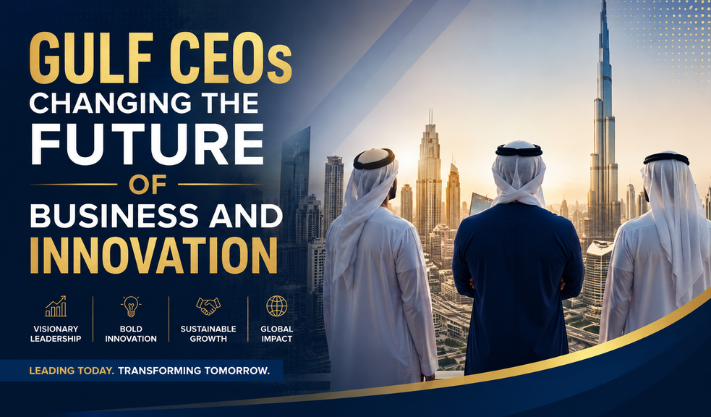
The Gulf business landscape is changing rapidly. Across Saudi Arabia, the United Arab Emirates, Qatar, Bahrain, Kuwait, and Oman, CEOs are leading companies through a period defined by technology, entrepreneurship, economic diversification, sustainability, and global expansion.
Today’s Gulf CEOs are not simply managing established businesses. Many are building new industries, investing in artificial intelligence, developing digital platforms, attracting international capital, and creating business models designed for a more connected global economy.
What Is Driving the Transformation of Gulf Business?
The transformation is being driven by several major forces, including economic diversification, digitalization, artificial intelligence, infrastructure development, and the growing role of private-sector businesses.
For decades, energy played a central role in many Gulf economies. While energy remains strategically important, governments and businesses are increasingly expanding into technology, tourism, financial services, logistics, healthcare, manufacturing, entertainment, and renewable energy.
This shift has created opportunities for CEOs to think beyond traditional business models and build companies that can compete internationally.
How Are Gulf CEOs Using Technology to Change Business?
Technology has become one of the strongest tools for business transformation across the Gulf.
CEOs are adopting cloud computing, automation, data analytics, artificial intelligence, cybersecurity, and digital customer platforms to improve efficiency and create new products and services.
Artificial intelligence is particularly important. Businesses are using AI to analyze customer behavior, automate repetitive processes, improve decision-making, personalize services, and identify new market opportunities.
For Gulf CEOs, technology is increasingly viewed not only as an operational tool but also as a strategic advantage.
Why Is Artificial Intelligence Important to Gulf Business Leaders?
AI is changing how companies operate and compete. Gulf CEOs are increasingly exploring AI because it can help organizations make faster decisions, reduce operational costs, improve productivity, and develop innovative services.
AI is also becoming important in sectors such as finance, healthcare, logistics, retail, energy, manufacturing, and government services.
The most forward-looking CEOs understand that successful AI adoption requires more than purchasing technology. Companies also need skilled employees, reliable data, strong cybersecurity, responsible governance, and a clear business strategy.
How Are Gulf CEOs Supporting Economic Diversification?
Economic diversification is one of the most important themes shaping Gulf business leadership.
Saudi Arabia’s Vision 2030, the UAE’s economic strategies, Qatar’s national development priorities, and similar initiatives across the region are encouraging businesses to participate in industries beyond traditional energy.
CEOs are responding by expanding into areas such as tourism, entertainment, technology, financial services, logistics, real estate, healthcare, education, and advanced manufacturing.
This diversification is creating a broader entrepreneurial ecosystem and encouraging companies to develop products for both regional and international markets.
What Role Does Entrepreneurship Play in the Gulf’s Future?
Entrepreneurship is becoming increasingly important to the Gulf economy.
Startups are emerging in fintech, e-commerce, artificial intelligence, health technology, mobility, food technology, cybersecurity, and other high-growth industries.
Gulf CEOs are contributing to this ecosystem by launching new ventures, investing in startups, forming strategic partnerships, and creating platforms that help entrepreneurs scale.
The growing presence of venture capital and international investors is also helping ambitious businesses access funding and expertise.
How Are Gulf CEOs Expanding Globally?
The modern Gulf CEO increasingly thinks beyond regional markets.
Companies headquartered in the Gulf are entering international markets through acquisitions, partnerships, investments, technology expansion, and new offices.
This global approach is transforming the region from primarily an investment destination into a source of international business leadership.
Gulf companies are increasingly competing for customers, talent, technology, and investment on a global scale.
Are Gulf CEOs Focusing on Sustainability?
Yes. Sustainability has become an important component of long-term business strategy.
Companies across the region are exploring renewable energy, energy efficiency, sustainable construction, responsible supply chains, electric mobility, water management, and lower-carbon technologies.
For CEOs, sustainability is increasingly connected to competitiveness. Businesses that use resources efficiently and respond to changing consumer and investor expectations can strengthen their long-term position.
The Gulf’s experience in energy also gives many regional companies a unique perspective on the transition toward a more diversified and sustainable economy.
How Are Gulf CEOs Changing the Workplace?
Business transformation is also changing how people work.
Gulf companies are investing in digital tools, employee development, flexible working models, leadership training, and specialized technology skills.
As AI and automation change traditional roles, CEOs increasingly need to focus on reskilling employees rather than simply replacing existing processes.
Leadership is becoming more collaborative, data-driven, and innovation-focused. Companies that can attract and retain highly skilled professionals will have a stronger advantage in competitive industries.
What Makes the New Generation of Gulf CEOs Different?
The new generation of Gulf CEOs tends to combine regional knowledge with a global perspective.
They are more comfortable working across borders, adopting emerging technologies, collaborating with startups, and responding quickly to changing consumer expectations.
Instead of focusing only on short-term growth, many leaders are considering ecosystem development, innovation, sustainability, digital transformation, and international competitiveness.
This represents a broader evolution in Gulf corporate leadership.
Which Industries Are Gulf CEOs Transforming Most?
Several industries are experiencing significant transformation.
Technology and AI: Companies are developing digital platforms, AI solutions, cloud services, and cybersecurity technologies.
Financial services: Fintech is changing payments, banking, investment, and financial access.
Tourism and entertainment: Major investments are creating new destinations, experiences, and hospitality businesses.
Logistics: The Gulf’s geographic position is supporting advanced transportation, warehousing, and supply-chain businesses.
Healthcare: Digital health, medical technology, and advanced healthcare services are becoming increasingly important.
Energy: Traditional energy businesses are exploring efficiency, clean technologies, and new energy solutions.
Manufacturing: Advanced manufacturing and industrial technology are supporting greater economic diversification.
What Can Global Businesses Learn From Gulf CEOs?
Global businesses can learn the importance of combining long-term vision with rapid execution.
Gulf markets demonstrate how government strategy, private investment, technology, infrastructure, and entrepreneurship can work together to accelerate economic transformation.
The region also highlights the importance of adapting global business models to local markets while maintaining international standards.
For international companies, the Gulf increasingly represents not only a market but also a strategic hub for reaching customers, investors, talent, and partners across multiple regions.
What Is the Future of Gulf Business Leadership?
The future of Gulf business leadership will likely be defined by innovation, technology, internationalization, sustainability, and talent.
CEOs will need to understand emerging technologies while maintaining a strong focus on customers and employees. They will also need to manage increasingly complex markets and respond to rapid technological change.
The leaders who succeed will be those who can turn ambitious ideas into scalable businesses while building organizations capable of adapting to change.
Why Are Gulf CEOs Important to the Future of Global Business?
Gulf CEOs are becoming increasingly influential because the region itself is evolving into a major center for investment, innovation, infrastructure, entrepreneurship, and international commerce.
Their decisions can influence not only individual companies but also broader industries and economic ecosystems.
As Gulf economies continue diversifying, business leaders will have opportunities to shape new markets rather than simply participate in existing ones.
Final Answer
Gulf CEOs are changing the future of business by combining technology, entrepreneurship, investment, sustainability, and global ambition. Their leadership is helping transform the Gulf from an economy historically associated with energy into a broader business ecosystem driven by innovation and diversification.
The next chapter of Gulf business will depend on how effectively these leaders embrace artificial intelligence, develop talent, support entrepreneurship, build sustainable businesses, and compete internationally. Their influence is likely to extend well beyond the region, making Gulf leadership an increasingly important force in the global economy.
Also Read:-
What Are the Top 10 Traditional Foods in the UAE?
Top Business Leaders Shaping the Middle East Economy
What Are the Benefits of Investing in Qatar?