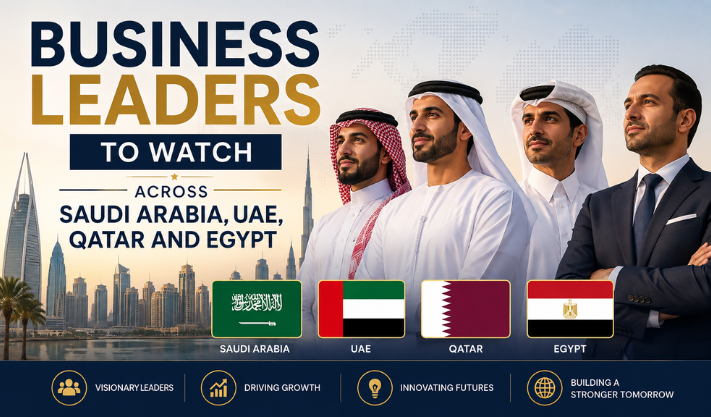
The Middle East is entering a new phase of business growth, driven by economic diversification, artificial intelligence, digital transformation, infrastructure investment, tourism, finance, energy and global expansion. Saudi Arabia, the UAE, Qatar and Egypt are playing especially important roles in this transformation.
In 2026, leadership across these markets is increasingly about more than managing large companies. Business leaders are being challenged to build new industries, attract international capital, adopt AI, develop talent and create companies capable of competing globally. Forbes Middle East’s 2026 Top 100 CEOs list includes 102 executives across 100 entries, with Emiratis representing 31 leaders, Egyptians 15 and Saudis 13.
Here are some of the business leaders worth watching and why their work matters.
Who are the business leaders to watch in Saudi Arabia?
Saudi Arabia is undergoing one of the region’s most ambitious economic transformations. Vision 2030 continues to encourage investment beyond oil, with growing attention on technology, tourism, entertainment, logistics, infrastructure and advanced industries.
Amin H. Nasser, President and CEO of Saudi Aramco, remains one of the most influential corporate leaders in the Kingdom. His leadership is particularly important as Saudi Arabia balances its traditional energy strength with investments in technology, chemicals, downstream industries and new growth opportunities. Forbes Middle East ranked Nasser first in its 2026 Top 100 CEOs list.
Olayan Mohammed Alwetaid, Group CEO of stc Group, is another executive to watch as Saudi Arabia develops its digital economy. Telecommunications companies increasingly operate as technology and digital infrastructure businesses, making connectivity, cloud services and digital solutions central to economic development.
John Pagano, Group CEO of Red Sea Global, represents another side of Saudi Arabia’s transformation. Tourism and large-scale destination development are becoming major components of the Kingdom’s diversification strategy.
Jerry Inzerillo, Group CEO of Diriyah Company, is also closely associated with Saudi Arabia’s efforts to develop cultural, tourism and urban destinations. These projects demonstrate how business leadership is becoming closely connected with the development of entirely new economic ecosystems.
Saudi CEOs are operating in an environment of strong growth expectations. PwC reported that 94% of surveyed Saudi CEOs were confident in domestic economic growth, while 80% said their organizational culture supports AI adoption.
Which UAE leaders are shaping the future?
The UAE continues to position itself as a global center for finance, aviation, technology, investment and entrepreneurship.
Sultan Ahmed Al Jaber, Managing Director and Group CEO of ADNOC and Executive Chairman of XRG, is a major figure in the country’s energy and industrial transformation. His leadership reflects the UAE’s effort to expand energy capabilities while investing in new technologies and lower-carbon opportunities.
Sheikh Ahmed bin Saeed Al Maktoum, Chairman and CEO of Emirates Airline and Group, is another leader to watch. Emirates remains one of the world’s most recognizable aviation businesses, and its performance has a wider impact on Dubai’s position as an international tourism, trade and transport hub.
Khaldoon Khalifa Al Mubarak, Managing Director and Group CEO of Mubadala Investment Company, represents the UAE’s increasingly global investment strategy. Sovereign investment organizations have become important vehicles for expanding the country’s presence across technology, healthcare, infrastructure, finance and other strategic sectors.
Hana Al Rostamani, Group CEO of First Abu Dhabi Bank, is also an important financial-sector leader. Banking and financial services represented the largest sector in Forbes Middle East’s 2026 CEO ranking, accounting for 30 entries.
The UAE’s leadership ecosystem is particularly significant for AI and technology. The country’s investment organizations and technology companies are pursuing international partnerships and large-scale digital infrastructure projects, reinforcing Abu Dhabi and Dubai’s ambitions as global technology hubs.
Who are the key business leaders to watch in Qatar?
Qatar’s business environment combines energy strength with growing ambitions in aviation, telecommunications, finance, tourism, sports and technology.
Hamad Ali Al-Khater, Group CEO of Qatar Airways, is one of the executives worth following. Qatar Airways has helped establish Doha as a major international aviation hub, making leadership in the sector important to Qatar’s wider global connectivity strategy.
Ahmad Helal Al-Mohannadi, CEO of QatarEnergy LNG, is another significant leader in the energy industry. Qatar’s LNG sector remains central to its global economic influence, while the country continues to explore opportunities connected to energy expansion and long-term sustainability.
Aziz Aluthman Fakhroo, Group CEO of Ooredoo Group, is important to watch from a digital transformation perspective. Telecommunications and digital infrastructure are becoming increasingly important as countries across the Gulf build connected economies.
Qatar is also represented strongly in the region’s leading business rankings. Forbes Middle East’s 2026 list identified 11 CEOs based in Qatar, while Gulf Business included several Qatar-based executives among its 50 leaders and CEOs of 2026.
Which Egyptian business leaders deserve attention?
Egypt represents one of the largest consumer and talent markets in the Arab world. Its business leaders are working across construction, banking, telecommunications, finance, industrial development and infrastructure.
Karim Awad, Group CEO and Chairman of EFG Holding, is one executive to watch in the financial-services sector. Financial institutions are playing a central role in supporting investment, entrepreneurship and economic activity across Egypt and the wider region.
Osama Bishai, CEO of Orascom Construction, is another important figure. Infrastructure and construction remain essential to Egypt’s economic development, while Egyptian companies are increasingly pursuing projects across international markets.
Randa Sadik, CEO of Arab Bank, represents the importance of financial leadership across the wider Middle East. Her role connects Egypt and the region through one of its major banking institutions.
Egyptian business leadership is also increasingly international. Forbes Middle East’s 2026 CEO ranking included 15 Egyptian executives, the second-highest nationality representation after the UAE.
Why are these four countries important for business leadership?
Saudi Arabia, the UAE, Qatar and Egypt have different economic structures, but their business leaders face several common priorities.
The first is economic diversification. Gulf economies are investing heavily in sectors beyond traditional energy, while Egypt is developing infrastructure, financial services, manufacturing and other growth industries.
The second is artificial intelligence. AI is moving from experimentation toward practical implementation. Forbes notes that companies across the region have increased investment in AI, digital infrastructure, energy transition and advanced manufacturing.
The third is international expansion. Regional companies are increasingly acquiring businesses, entering new markets and forming global partnerships. For example, Emirates NBD’s 2026 acquisition of a majority stake in India’s RBL Bank illustrates how Gulf financial institutions are expanding internationally.
What qualities define the next generation of Middle Eastern business leaders?
The strongest leaders are likely to combine financial discipline with technological awareness, international thinking and the ability to manage rapid change.
They must understand AI without losing sight of people. They need to attract global investment while developing local talent. They also have to respond to geopolitical uncertainty while continuing to invest for the long term.
PwC’s 2026 Middle East CEO survey found that 88% of surveyed CEOs expected economic growth to strengthen in their own territories, while 93% of GCC CEOs shared that expectation.
What should investors and entrepreneurs watch next?
Investors should pay close attention to companies operating in AI, digital infrastructure, financial services, tourism, logistics, energy, healthcare, advanced manufacturing and large-scale infrastructure.
Entrepreneurs should watch how established leaders build partnerships between governments, corporations and startups. These collaborations could create new opportunities for smaller businesses to participate in major economic transformation projects.
Final takeaway: Why do these leaders matter?
The business leaders of Saudi Arabia, the UAE, Qatar and Egypt are helping shape one of the world’s fastest-changing commercial regions. Their decisions affect not only individual companies but also investment flows, employment, technology adoption and national economic diversification.
From Saudi Arabia’s Vision 2030 transformation to the UAE’s global investment ambitions, Qatar’s energy and connectivity strategy and Egypt’s expanding infrastructure and financial ecosystem, the region offers a powerful mix of established corporate leadership and emerging opportunities.
For anyone following Middle Eastern business in 2026, these leaders—and the companies and industries they represent—are worth watching closely.
Also Read:-
What Are the Best Motivation Tips for Business Owners?
How Do You Choose the Best Hotel in the UAE?
Gulf CEOs Driving Business and Innovation Into the Future