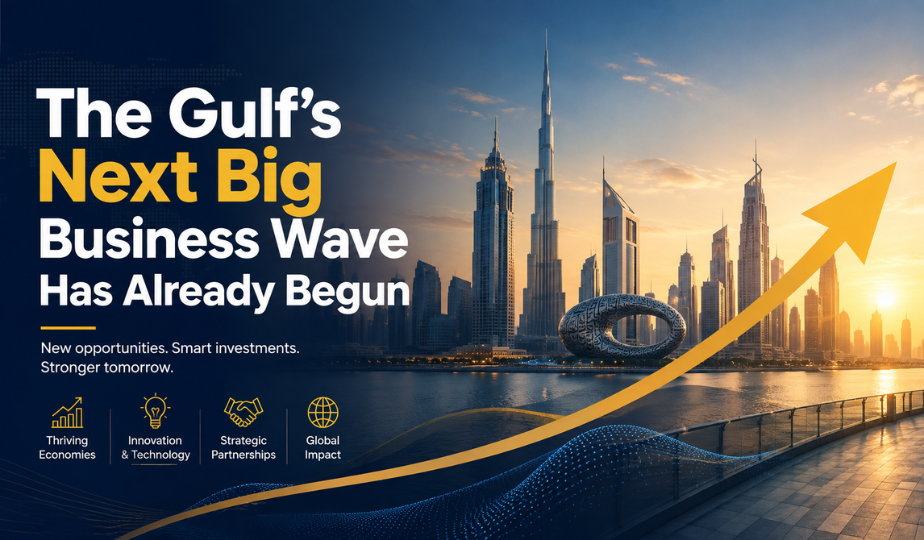
The Gulf region is entering a new phase of economic growth. For decades, oil and gas shaped the economies of countries such as Saudi Arabia, the United Arab Emirates, Qatar, Kuwait, Bahrain, and Oman. Today, however, a broader business transformation is underway.
From artificial intelligence and fintech to tourism, logistics, renewable energy, healthcare, and digital services, the Gulf is building a more diversified economy. Governments are investing heavily in infrastructure, technology, talent, and entrepreneurship, while private companies and startups are creating new opportunities across the region.
But what exactly is driving the Gulf’s next business wave? And which industries are most likely to shape its future?
What Is the Gulf’s Next Big Business Wave?
The Gulf’s next business wave is the shift from resource-dependent growth toward a diversified, technology-driven economy.
This transformation is being supported by large-scale national development strategies, expanding private-sector investment, rising digital adoption, and a growing startup ecosystem. Instead of relying primarily on hydrocarbons, Gulf economies are increasingly developing businesses around technology, tourism, financial services, healthcare, logistics, entertainment, manufacturing, and sustainability.
The result is an economic environment where both established companies and emerging entrepreneurs can find new opportunities.
Why Is the Gulf Economy Changing So Quickly?
Several forces are accelerating economic change across the Gulf.
Governments are investing in modern infrastructure, digital transformation, education, tourism, and new industries. At the same time, young and increasingly tech-savvy populations are creating demand for digital products and modern services.
Another major factor is the region’s strategic location. The Gulf sits between major markets in Asia, Europe, and Africa, giving businesses access to important international trade routes and consumer markets.
The combination of capital, infrastructure, strategic geography, and government support is creating an attractive environment for new businesses.
Is Artificial Intelligence Becoming a Major Gulf Business Opportunity?
Yes. Artificial intelligence is emerging as one of the most important areas of investment and innovation across the Gulf.
Businesses are exploring AI for everything from customer service and financial analysis to healthcare, logistics, cybersecurity, manufacturing, and government services.
The opportunity is not limited to developing AI models. Companies can also build businesses around AI implementation, data management, automation, enterprise software, AI consulting, and specialized applications.
As organizations across the region digitize their operations, demand for practical AI solutions is expected to continue growing.
How Is Fintech Changing Business in the Gulf?
Fintech is another major part of the region’s transformation.
Digital payments, mobile banking, online lending, wealth technology, embedded finance, and financial management platforms are changing how consumers and businesses interact with financial services.
The Gulf has several advantages in this area, including strong banking systems, high smartphone adoption, substantial investment capital, and digitally connected consumers.
For entrepreneurs, this creates opportunities to develop financial products that address specific regional needs while potentially expanding into international markets.
Is Tourism Becoming a Major Economic Driver?
Tourism is quickly becoming one of the Gulf’s most important diversification opportunities.
Countries across the region are investing in luxury hospitality, entertainment, cultural attractions, sports events, conferences, theme parks, cruise tourism, and destination infrastructure.
Saudi Arabia, the UAE, Qatar, Oman, and other Gulf markets are developing different tourism propositions, creating opportunities for hotels, travel technology companies, restaurants, entertainment businesses, event companies, transportation providers, and experience-based startups.
The future of Gulf tourism is increasingly about more than traditional luxury travel. It is also about creating distinctive experiences that attract international visitors and encourage longer stays.
Why Is Logistics Important to the Gulf’s Future?
The Gulf’s geographic position makes logistics and transportation particularly important.
Major ports, airports, highways, free zones, and industrial hubs connect the region with international markets. As global supply chains become more sophisticated, demand is increasing for advanced logistics solutions.
Technology can play a major role through automated warehouses, supply-chain software, delivery platforms, smart ports, fleet management, and predictive analytics.
This creates an opportunity for the Gulf to become not only a regional trading center but also a technology-enabled global logistics hub.
What Role Will Renewable Energy Play?
The energy transition is creating another major business opportunity.
Gulf countries have significant potential in solar power because of their geography and abundant sunlight. Investments in renewable energy, energy efficiency, electric mobility, battery technologies, and sustainable infrastructure are creating new markets.
Importantly, the transition does not mean that traditional energy expertise becomes irrelevant. Instead, existing energy capabilities can increasingly support new areas such as clean energy, hydrogen, carbon management, and advanced industrial technologies.
This combination could help create a new generation of energy businesses across the region.
How Are Gulf Startups Contributing to Economic Growth?
Startups are becoming increasingly important to the Gulf’s business ecosystem.
Entrepreneurs are developing solutions for regional challenges in areas such as healthcare, education, commerce, transportation, financial services, food technology, property technology, and artificial intelligence.
Access to venture capital and government-backed initiatives can help promising companies scale faster. At the same time, the region’s relatively high purchasing power can provide startups with a strong early customer base.
The biggest opportunity may come from startups that solve local problems while building products capable of serving international markets.
Why Is Healthcare Emerging as a Business Opportunity?
Healthcare is another sector experiencing rapid transformation.
Gulf countries are investing in hospitals, medical technology, digital health, preventive care, biotechnology, wellness, and healthcare infrastructure.
Technology is helping expand access to services through telemedicine, digital health records, remote monitoring, AI-assisted diagnostics, and personalized healthcare solutions.
As populations grow and healthcare expectations increase, businesses that combine technology with high-quality healthcare delivery could become increasingly important.
What Does the Future Hold for Gulf Entrepreneurs?
The Gulf’s evolving economy creates opportunities for entrepreneurs who understand both technology and regional market needs.
The strongest businesses may not simply copy successful ideas from other markets. Instead, they may adapt global technologies to solve specific challenges in the Gulf.
Entrepreneurs should also think beyond individual countries. A successful business model developed in Dubai, Riyadh, Doha, or another Gulf market may eventually be expanded across the wider Middle East, Africa, and Asia.
Which Industries Could Lead the Gulf’s Next Business Cycle?
Several sectors appear particularly well positioned:
- Artificial intelligence and enterprise technology
- Fintech and digital payments
- Tourism and hospitality
- Logistics and supply-chain technology
- Renewable energy and sustainability
- Healthcare and biotechnology
- E-commerce and digital services
- Entertainment and sports
- Advanced manufacturing
- Real estate technology
- Cybersecurity and cloud services
- Education technology
These industries are different, but they share one important characteristic: they support the transition toward a more diversified and digitally connected economy.
Is the Gulf Becoming a Global Business Hub?
The Gulf is increasingly positioning itself as a bridge between global markets.
Its combination of capital, infrastructure, strategic location, ambitious development programs, and growing technology capabilities gives the region a strong foundation for international business.
Major cities are competing not only to attract companies but also to attract entrepreneurs, investors, skilled professionals, and innovators.
That competition can encourage further improvements in infrastructure, regulation, technology, and business services.
What Is the Biggest Opportunity in the Gulf’s Next Business Wave?
The biggest opportunity may not belong to one particular industry. Instead, it could come from the intersection of several industries.
For example, AI can transform healthcare. Fintech can support tourism. Renewable energy can power industrial development. Logistics technology can strengthen e-commerce. Smart infrastructure can connect all of these sectors.
This interconnected approach is what makes the Gulf’s transformation particularly significant.
What Should Businesses Watch Next?
Businesses should watch five major trends: artificial intelligence adoption, private-sector expansion, tourism growth, clean-energy investment, and the development of regional startup ecosystems.
Companies that understand these trends early can identify new customers, partnerships, investment opportunities, and emerging markets.
The Gulf’s transformation is not simply about building more infrastructure or attracting more investment. It is about creating a new economic model where technology, entrepreneurship, international trade, and diversified industries work together.
Final Takeaway: Has the Gulf’s Next Business Wave Already Begun?
Yes. The transformation is already visible.
The Gulf is moving toward an economy where oil and gas remain important but coexist with technology, tourism, finance, healthcare, logistics, renewable energy, manufacturing, and entrepreneurship.
For businesses and investors, this creates a region full of emerging opportunities. For entrepreneurs, it offers a growing market with access to capital, infrastructure, technology, and international connections.
The next big Gulf business story may therefore not be about one company, one city, or one industry. It may be about an entire region building a broader, more innovative economic future—and that business wave has already begun.
Also Read:-
What Are the Most Popular Fashion Brands in Dubai?
The Rise of New Business Powerhouses Across the Middle East
How to Start an Energy Business in the UAE?