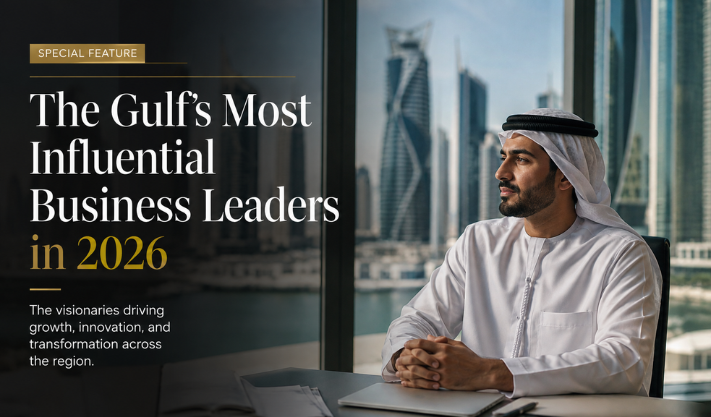
The Gulf region is entering 2026 with a business landscape defined by diversification, artificial intelligence, global investment, tourism, infrastructure, energy transition, and digital transformation. Across Saudi Arabia, the United Arab Emirates, Qatar, Kuwait, Bahrain, and Oman, business leaders are increasingly responsible not only for corporate performance but also for helping shape broader economic transformation.
Recent regional rankings underline the scale of this leadership shift. Forbes Middle East’s 2026 Top 100 CEOs includes 102 executives across 100 entries and 21 nationalities, with the UAE, Saudi Arabia, and Qatar hosting the largest concentrations of leaders.
Who are the Gulf’s most influential business leaders in 2026?
The Gulf’s influential business leaders include executives such as Amin H. Nasser of Saudi Aramco, Sultan Ahmed Al Jaber of ADNOC, Khaldoon Khalifa Al Mubarak of Mubadala Investment Company, Sheikh Ahmed bin Saeed Al Maktoum of Emirates Group, Hana Al Rostamani of First Abu Dhabi Bank, John Pagano of Red Sea Global, Mohamed Jameel Al Ramahi of Masdar, and Tony Douglas of Riyadh Air.
These executives represent sectors ranging from energy and investment to aviation, banking, tourism, technology, and sustainability. Gulf Business’ 2026 leadership list similarly highlights executives across the region who are driving transformation and creating more globally connected businesses.
Why is Amin H. Nasser an influential Gulf business leader?
Amin H. Nasser, President and CEO of Saudi Aramco, remains one of the most important corporate leaders in the Gulf because of the scale and global significance of the energy industry.
His leadership reflects Saudi Arabia’s effort to maintain its position in traditional energy while simultaneously expanding into technology, chemicals, advanced manufacturing, and new areas of the energy economy. Forbes Middle East ranked Nasser No. 1 in its 2026 Top 100 CEOs list.
His influence therefore extends beyond oil production. The decisions made by Saudi Aramco affect global energy markets, investment strategies, technology development, and Saudi Arabia’s broader economic ambitions.
What makes Sultan Al Jaber important to Gulf business?
Sultan Ahmed Al Jaber, Managing Director and Group CEO of ADNOC and Executive Chairman of XRG, represents the Gulf’s changing approach to energy leadership.
His role connects traditional energy infrastructure with investments in lower-carbon technologies, industrial development, and international partnerships. Gulf Business included him among its leading executives for 2026, while Forbes Middle East placed him second in its Top 100 CEOs ranking.
His leadership illustrates how Gulf energy companies are increasingly positioning themselves as diversified global businesses rather than simply resource producers.
Why is Khaldoon Al Mubarak one of the Gulf’s most influential leaders?
Khaldoon Khalifa Al Mubarak, Managing Director and Group CEO of Mubadala Investment Company, occupies a unique position at the intersection of sovereign investment, technology, infrastructure, healthcare, finance, and international business.
Mubadala reported a 17% increase in assets under management during 2025, reaching approximately $385 billion, according to Gulf Business.
That scale gives Al Mubarak considerable influence over where capital is deployed and which industries receive long-term investment. His leadership demonstrates the Gulf’s growing role as a global capital provider.
How is Sheikh Ahmed bin Saeed Al Maktoum shaping Gulf aviation?
Sheikh Ahmed bin Saeed Al Maktoum, Chairman and CEO of Emirates Group, represents Dubai’s position as a global aviation and tourism hub.
Emirates connects the Gulf with major markets across Asia, Europe, Africa, North America, and beyond. Its leadership is therefore closely connected with Dubai’s wider strategy of maintaining its status as an international business, tourism, and logistics center.
Forbes Middle East ranked Sheikh Ahmed third in its 2026 Top 100 CEOs list.
What role does Hana Al Rostamani play in Gulf business?
Hana Al Rostamani, Group CEO of First Abu Dhabi Bank, represents the growing influence of financial leadership in the Gulf.
Banking and financial services accounted for 30 entries in Forbes Middle East’s 2026 Top 100 CEOs ranking, making it the largest sector represented.
Financial institutions are central to Gulf diversification because they provide capital for infrastructure, technology, real estate, international expansion, and entrepreneurship. Leaders such as Al Rostamani are therefore helping shape how regional businesses access and deploy capital.
Why is John Pagano significant to Saudi Arabia’s transformation?
John Pagano, Group CEO of Red Sea Global, is closely associated with Saudi Arabia’s rapidly expanding tourism and destination-development sector.
His work reflects the Kingdom’s ambition to build globally competitive tourism destinations while incorporating sustainability, hospitality, infrastructure, and technology.
Tourism has become an increasingly important component of Saudi Arabia’s economic diversification strategy, making destination-development leaders increasingly influential within the region’s business ecosystem.
How is Mohamed Jameel Al Ramahi influencing the energy transition?
Mohamed Jameel Al Ramahi, CEO of Masdar, represents another important dimension of Gulf leadership: renewable energy and international sustainability investment.
Masdar’s expansion reflects the UAE’s ambition to participate in the global energy transition while maintaining its position as a major energy and investment center.
This combination of energy expertise, international investment, and clean-technology development is becoming increasingly important to Gulf corporate strategy.
Why is Tony Douglas important for Saudi Arabia’s aviation future?
Tony Douglas, CEO of Riyadh Air, is helping lead one of Saudi Arabia’s most ambitious aviation projects.
Riyadh Air is designed to strengthen Saudi Arabia’s international connectivity and support the Kingdom’s expanding tourism, business, and investment ecosystem. Its development also demonstrates how aviation is being used as an economic-development tool rather than simply a transportation service.
What trends are shaping Gulf business leadership in 2026?
Several major trends define the region’s leadership environment.
1. Artificial intelligence
AI is moving from experimentation toward practical implementation. At LEAP 2026, technology leaders discussed Saudi Arabia’s expanding AI ecosystem and its ambitions to become a major regional AI hub.
2. Economic diversification
Gulf economies are increasingly developing sectors beyond hydrocarbons, including tourism, finance, technology, logistics, healthcare, entertainment, and advanced manufacturing.
3. Global investment
Gulf companies and sovereign investment organizations are increasingly looking beyond their domestic markets. Forbes highlighted diversification and international acquisitions as major characteristics of the region’s corporate strategy in 2026.
4. Sustainability and energy transition
Traditional energy companies are investing alongside renewable-energy and lower-carbon businesses, creating a more complex Gulf energy ecosystem.
5. Resilience and adaptability
Regional leaders are operating against a backdrop of geopolitical uncertainty and changing global financial conditions. Recent Gulf market movements demonstrate how external developments can quickly affect investor sentiment and business confidence.
What makes Gulf business leaders different in 2026?
The defining characteristic of Gulf leadership in 2026 is scale combined with transformation.
Today’s leading executives are managing organizations that increasingly operate across multiple countries, industries, and technologies. They are expected to protect financial performance while also supporting innovation, attracting international investment, developing talent, and responding to rapidly changing consumer and technological trends.
Gulf Business describes its 2026 selection as a group of leaders whose decisions and business capabilities are helping define a more ambitious and globally connected MENA economy.
What is the future of Gulf business leadership?
The next generation of Gulf business leadership will likely be defined by leaders who can combine technology, capital, sustainability, international expansion, and long-term strategic thinking.
Also Read:-
UAE Visa Rules 2026: Latest Changes Explained
What Are the Best Business Opportunities for Arab Youth in MENA?
What Are the AI Business Opportunities in Qatar?