For more than three decades, I have worked across conflict zones, humanitarian emergencies, and fragile states. Throughout that time, one reality has remained painfully consistent. Families who have lost everything are often provided with shelters that were never designed to last. Plastic tarpaulins and lightweight tents may offer immediate protection, but within months they deteriorate, leaving already vulnerable people exposed once again. Yet many refugee camps remain in existence not for weeks or months, but for 10, 20, or even 30 years.
That contradiction became the inspiration behind Dignity Designed and Delivered, a not-for-profit social enterprise established in 2019 and headquartered in Cleveland, Ohio. Founded to bring together the international development expertise of Geopolicity Inc. with the world-renowned product innovation capabilities of Nottingham Spirk, our ambition has always been straightforward: to fundamentally rethink humanitarian shelter through world-class design, engineering and innovation while restoring dignity to some of the world’s most vulnerable people.
We recognized that the humanitarian shelter system had become trapped in a cycle of short-term planning for what have increasingly become long-term crises. Funding is generally allocated annually, procurement often prioritizes the lowest purchase price, and temporary solutions are repeatedly deployed into crises that have become anything but temporary. The result is that millions of displaced families continue to live in shelters that were designed to last months but end up being occupied for decades.
We believed the humanitarian sector deserved a fundamentally different approach.
A Humanitarian System Under Increasing Pressure
The need for innovation has never been greater.
Today, more than 122 million people are forcibly displaced worldwide, while approximately 14 million people lose their homes every year because of sudden disasters. At the same time, humanitarian appeals continue to grow while many traditional donor governments are reducing overseas assistance as resources are increasingly redirected towards domestic priorities and major geopolitical crises. The humanitarian system is therefore being asked to respond to record levels of need with increasingly constrained financial resources.
The consequences are profound. Humanitarian assistance continues to be planned largely around annual funding cycles, yet displacement is becoming increasingly protracted. Many refugee settlements now exist for decades rather than months. Families who fled conflict as children often become parents, and even grandparents, without ever leaving the camp.
This reality demands an entirely different approach to humanitarian shelter.
From Emergency Shelter to Long-Term Dignity
Our vision was never simply to build another emergency tent.
Instead, we set out to create what we describe as an intermediate shelter, a solution capable of responding immediately after disasters while remaining suitable for medium- and long-term deployment.
The objective was simple: to design a shelter that could be deployed for one month, six months, five years, or even ten years, depending on the circumstances. Rather than becoming another consumable humanitarian product, the shelter would become a reusable humanitarian asset.
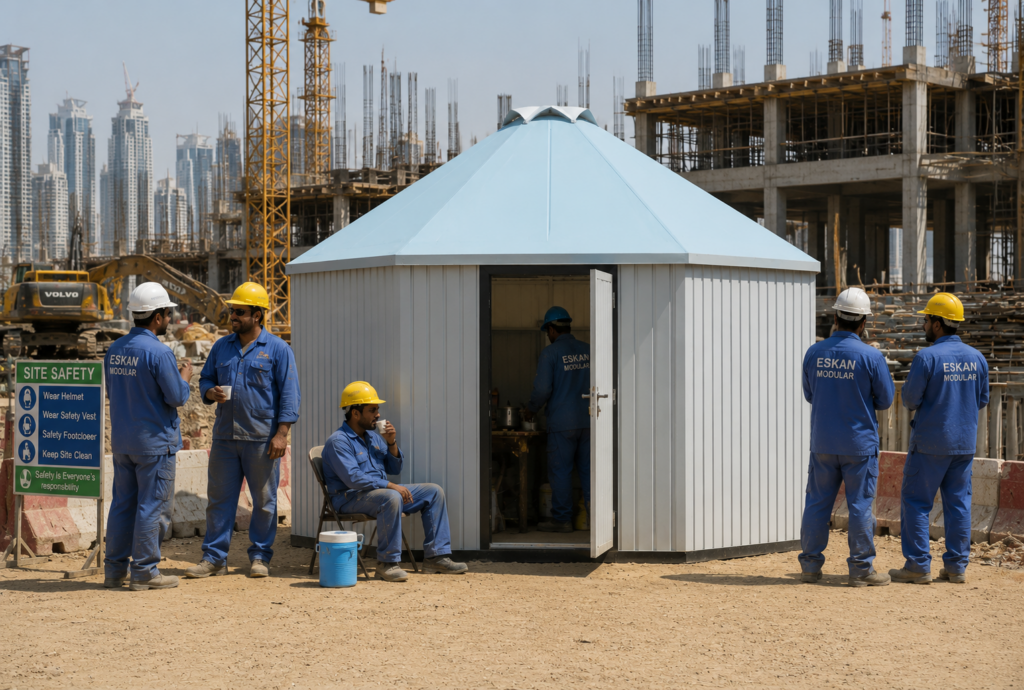
Our patented modular shelter goes far beyond the traditional concept of temporary accommodation. Engineered as a configurable system of interchangeable insulated floor, wall, and roof panels, it can be assembled rapidly, dismantled just as easily, transported efficiently, and redeployed repeatedly over many years. Individual shelters can operate independently or connect together to create larger living spaces, classrooms, schools, health clinics, vaccination centers, community facilities, offices, and even entire neighbourhoods.
The design incorporates adjustable foundations for uneven terrain, weatherproof sealing, optional electrical integration, thermal insulation, and multiple configuration options that transform emergency shelter into resilient community infrastructure.
In 2025, the technology received a United States patent, with additional patent applications progressing across the United Arab Emirates, India, and China, reflecting the global potential of the innovation.
Innovation That Changes the Economics of Humanitarian Assistance
As an economist, I also wanted to challenge another long-held assumption. Humanitarian procurement has traditionally focused on the lowest purchase price rather than the lowest lifecycle cost.
A shelter costing US$1,000 that survives for only one year may initially appear inexpensive. Yet, for a family of four, it costs approximately US$250 per person per year before it must be replaced.
By comparison, our shelter costs approximately US$2,500 but is designed to remain operational for up to ten years. Spread across a family of four over its full lifespan, the annual cost falls to just US$62.50 per person per year, making it almost four times more cost-effective while providing vastly superior safety, privacy, comfort, and resilience.
The economics become even more compelling because the shelter is not discarded after a single deployment. It can be dismantled, stored, transported, and redeployed repeatedly wherever it is needed next. Every additional deployment further reduces its effective lifecycle cost while increasing its humanitarian value.
In other words, humanitarian agencies are no longer purchasing a temporary shelter. They are investing in durable infrastructure that retains its value over many years. We believe procurement should increasingly measure cost per protected person per year, rather than simply the initial purchase price.
Designed Around People, Especially Women and Children
The starting point for our design process was never engineering alone. It was people.
Humanitarian shelter has traditionally been designed to solve an urgent logistical challenge: getting something over a family’s head as quickly and as affordably as possible following a disaster or conflict. That objective remains essential, and our shelter has been engineered to do exactly that. But we believed humanitarian shelter should achieve much more.
In addition to providing immediate protection, we wanted to solve the equally important human challenges of dignity, privacy, security, safety, comfort, and inclusion. Families who have lost everything should not simply survive. They should be given the opportunity to recover in an environment that respects their humanity.
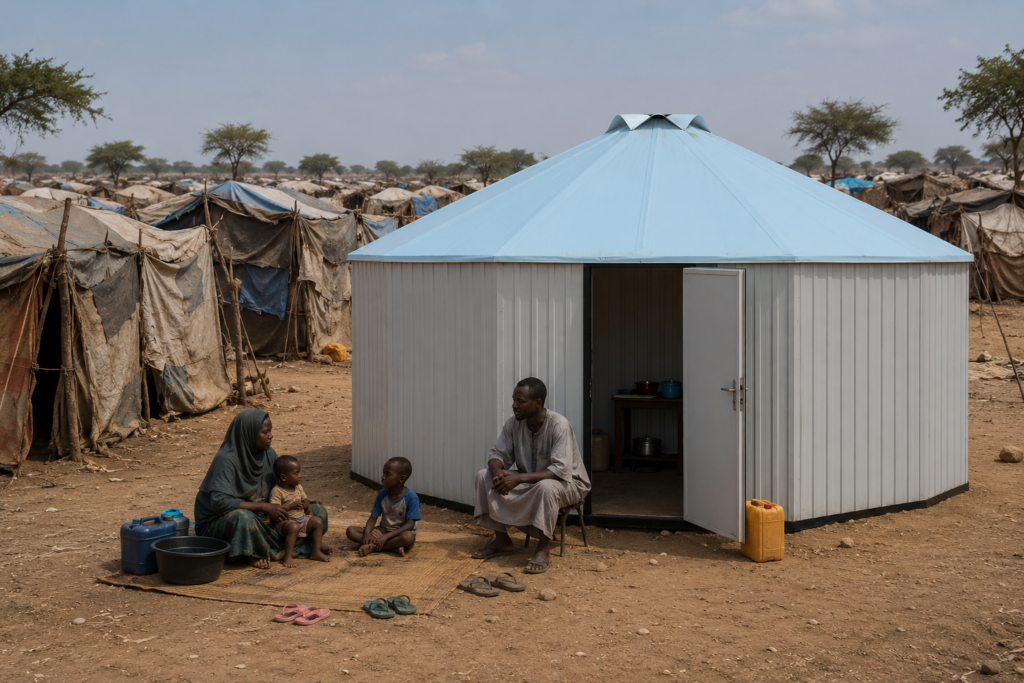
Women and children account for the majority of the world’s displaced population and are often the most vulnerable to violence, exploitation, and insecurity. In many refugee settlements, families live for years in shelters that provide little privacy, no security, and inadequate protection from extreme temperatures. Doors cannot be locked, windows provide limited ventilation and security, and the structures themselves deteriorate rapidly under harsh environmental conditions.
Every major design decision was therefore guided by the principles of dignity, gender equality, safety, and inclusion.
Our shelters incorporate lockable doors and windows, insulated wall panels, integrated mosquito protection, durable weather-resistant construction, and secure family living spaces that provide genuine privacy. Rather than simply protecting people from the elements, they restore safety, independence, and dignity during periods of profound uncertainty.
The philosophy extends well beyond individual homes. Because the modular system can be interconnected, entire communities can be established rapidly, including classrooms, libraries, health facilities, vaccination centres, community centres, and administrative buildings. Shelter therefore becomes the foundation upon which education, healthcare, livelihoods, and communities can begin again.
Innovation, Sustainability, and Modularity
From the very beginning, every engineering decision was driven by one simple question:
How do we create a shelter that is as simple to deploy as a humanitarian tent, yet performs like a permanent building?
The result is a shelter that combines engineering simplicity with long-term resilience.
Every unit is delivered flat-packed to maximize international shipping efficiency and can be assembled by just two people in approximately two hours, requiring no specialist tools, no ladders, and no heavy lifting equipment. A unique tool-free fastening system allows rapid assembly in some of the world’s most difficult operating environments, dramatically reducing deployment costs while enabling humanitarian agencies to establish safe accommodation almost immediately after arrival.
Built around unique interlocking insulated steel-clad panels, the shelter provides approximately 16 square metres (172 square feet) of secure living space, comfortably accommodating families of up to five people. The highly insulated wall system, galvanized powder-coated steel frame, central ventilation system, fire- and UV-resistant roof, insect-screened windows, and high-security lockable door create an environment that is safer, healthier, and considerably more durable than traditional emergency shelter.
Unlike conventional humanitarian tents that often require replacement within a year, our shelter is designed to remain operational for five to ten years before being dismantled, stored, and redeployed elsewhere. The same shelter can therefore support emergency response, stabilization, early recovery, and long-term displacement without changing the underlying infrastructure.
The logistics are equally compelling. Flat-pack shipping enables exceptionally efficient container utilization, significantly reducing transportation costs and simplifying deployment into remote or disaster-affected areas. Local communities can assemble the shelters themselves without specialist contractors, cranes, or heavy machinery, helping humanitarian agencies move from delivery to occupation in a matter of hours rather than days.
Perhaps even more importantly, the shelter represents a flexible building platform. The same modular architecture can support emergency housing, transitional accommodation, schools, health clinics, administrative offices, workforce accommodation, construction camps, mining operations, oil and gas facilities, tourism infrastructure, and many other commercial applications. Rather than designing separate buildings for separate purposes, we have created a single adaptable platform capable of evolving alongside changing human needs.
This philosophy of innovation, sustainability, and modularity lies at the heart of everything we do. We are not simply manufacturing shelters. We are developing resilient infrastructure that dramatically reduces lifecycle costs, material waste, and environmental impact while improving humanitarian outcomes. It is proof that outstanding design can simultaneously deliver better engineering, stronger economics, and greater human dignity.
A Social Enterprise That Funds Humanitarian Impact
As development progressed, it became increasingly clear that the technology’s potential extended well beyond humanitarian response.
The same shelter platform could transform accommodation across construction, mining, oil and gas, defense, tourism, major infrastructure projects, and workforce housing throughout rapidly growing economies, particularly across the Gulf, Africa, and Asia.
That insight led to the creation of Eskan Modular, our commercial business.
Together, Dignity Designed and Delivered and Eskan Modular represent a new model of social enterprise, one in which commercial revenues generated in developed and emerging markets help finance humanitarian deployment where the need is greatest.
Rather than relying solely upon charitable donations or government funding, we believe commercial success can directly accelerate humanitarian impact. Every commercial project undertaken creates additional opportunities to expand humanitarian deployment, invest in further innovation, and increase our global impact. It is a model that demonstrates that commercial success and humanitarian impact are not competing objectives. They strengthen one another.
Looking Towards the Future
The need for resilient shelter will only increase.
Africa’s population is projected to approach four billion people by the end of this century. Climate change, resource scarcity, conflict, rapid urbanization, and economic inequality are all expected to place increasing pressure on communities across the continent. These pressures will inevitably contribute to greater levels of displacement and migration, with many people seeking opportunities beyond their national borders.
For Gulf countries in particular, investing in long-term resilience, especially across the Horn of Africa and neighboring regions, represents not only a humanitarian responsibility but also a strategic investment in regional stability, economic development, and the management of future migration pressures. Investing in resilient communities today is likely to reduce the humanitarian, political, and economic costs of unmanaged migration tomorrow.
Built Through Extraordinary Collaboration
This initiative has only been possible because of exceptional collaboration between international development practitioners, economists, engineers, industrial designers, and commercial innovators.
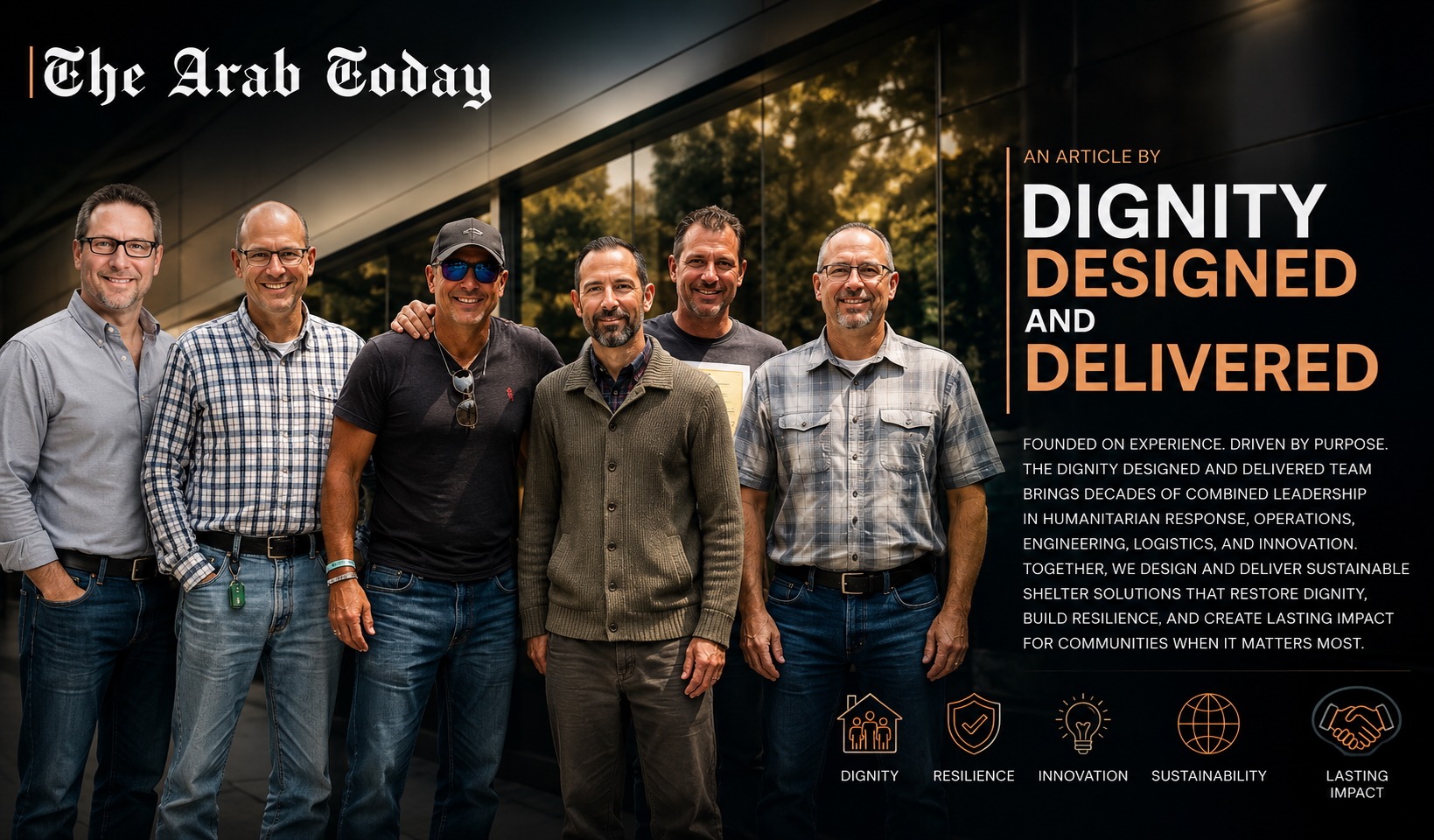
Dignity Designed and Delivered was initiated by Peter J. Middlebrook, Joachim Gfoeller, John Nottingham, John Spirk, and Sharon Miller, together with the remarkable design and engineering team at Nottingham Spirk, including Ben Parker, Mark Cipolla, Dave Pehar, and Trevor Jackson. The wider project has also benefited enormously from the invaluable contributions of Amba Tadaa and Eleni Kubolli.
Collectively, the team has challenged long-held assumptions about humanitarian shelter and demonstrated that world-class design innovation can simultaneously improve humanitarian outcomes, strengthen sustainability, and create commercially viable solutions that expand social impact.
Join Us
Every humanitarian crisis begins with the same urgent question:
Where will people sleep tonight?
For decades, the world has answered that question with temporary solutions to increasingly permanent problems. We believe there is a better way.
Dignity Designed and Delivered and Eskan Modular were created to demonstrate that humanitarian innovation, commercial sustainability, and social impact can work together to transform millions of lives. Through better design, smarter economics, and an unwavering commitment to dignity, we believe the humanitarian shelter sector can move beyond short-term relief towards long-term resilience.
We are actively seeking governments, United Nations agencies, NGOs, philanthropic foundations, investors, and commercial partners across the Middle East, Africa, Central Asia, Asia, and Europe who share our vision of creating a more resilient, sustainable, and dignified future.
Together, we can fundamentally change the way the world responds to displacement and ensure that millions of families no longer have to spend decades living in shelters that were only ever intended to last a few months.
Because the ultimate measure of humanitarian assistance is not how cheaply we provide shelter. It is how effectively we restore dignity, security, and hope.
If you are interested in learning more or exploring partnerships, please email the CEO at ceo@geopolicity.com
Also Read:-
Why Is the UAE Economy Growing So Fast?
Microsoft’s AI Buildout Led to 25% Rise in Carbon Emissions
Range Rover SV Long Wheelbase: Luxury SUV Excellence