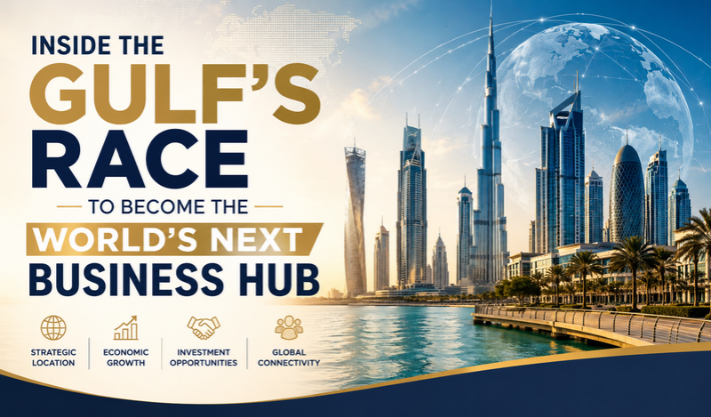
The Gulf region is undergoing a major economic transformation. Countries that were once strongly associated with oil and gas are now competing to become global centers for technology, finance, tourism, logistics, entrepreneurship, and innovation.
From Saudi Arabia and the United Arab Emirates to Qatar, Bahrain, Oman, and Kuwait, governments are investing heavily in infrastructure, digital transformation, talent, and international business partnerships. The goal is clear: build economies that can compete on a global scale.
But what is driving the Gulf’s race to become the world’s next business hub, and which factors will determine who succeeds?
What is driving the Gulf’s ambition to become a global business hub?
The Gulf’s ambition is being driven by economic diversification, strategic government investment, and a desire to attract international companies and talent.
Oil and gas remain important to many Gulf economies, but governments increasingly recognize that long-term competitiveness requires broader economic foundations. As a result, national development strategies are supporting sectors such as artificial intelligence, fintech, renewable energy, healthcare, advanced manufacturing, tourism, logistics, and e-commerce.
The region also has a strategic geographic advantage. Located between Europe, Asia, and Africa, the Gulf can serve as a natural bridge for global trade and investment.
Why is Saudi Arabia becoming a major business destination?
Saudi Arabia is one of the most ambitious players in the Gulf’s economic transformation.
Through Vision 2030, the Kingdom is working to diversify its economy, encourage private-sector growth, develop new industries, and attract international investment. Large-scale projects and developments are creating opportunities across tourism, technology, entertainment, infrastructure, logistics, real estate, and renewable energy.
Riyadh is also strengthening its position as a regional headquarters destination. As more multinational companies establish or expand operations in the Kingdom, demand is increasing for professional services, technology, finance, consulting, and specialized talent.
The scale of Saudi Arabia’s domestic market gives it another advantage: companies entering the country can potentially access a large consumer and business ecosystem.
Why is the UAE already one of the Gulf’s strongest business hubs?
The United Arab Emirates has spent decades developing itself as an international business and investment destination.
Dubai has built a global reputation around finance, tourism, aviation, real estate, technology, and international trade. Abu Dhabi, meanwhile, has become increasingly influential in investment, energy, technology, and advanced industries.
The UAE’s strengths include world-class infrastructure, international connectivity, business-friendly economic zones, and a highly international population.
Its airports, ports, financial centers, free zones, and digital infrastructure have helped make the country an important gateway between global markets.
How are technology and artificial intelligence changing the Gulf’s business landscape?
Technology is becoming one of the most important elements of the Gulf’s economic transformation.
Governments and businesses across the region are investing in artificial intelligence, cloud computing, cybersecurity, fintech, smart cities, automation, and digital services.
AI is particularly significant because it can influence almost every major industry. Financial institutions can use AI for fraud detection and customer services. Healthcare providers can apply advanced technologies to diagnostics and research. Logistics companies can improve supply-chain efficiency, while governments can use digital platforms to deliver public services more efficiently.
This technology race is also helping the Gulf attract startups, investors, engineers, researchers, and technology companies from around the world.
Which Gulf countries are competing to become business hubs?
Saudi Arabia and the UAE are the most prominent competitors, but other Gulf economies are developing specialized advantages.
Qatar has strengthened its position in finance, sports, tourism, education, energy, and international investment. Doha’s global profile has also increased significantly through major international events and infrastructure development.
Bahrain has developed a reputation for financial services and fintech, while its relatively small market allows it to position itself as an agile environment for certain businesses.
Oman is focusing on logistics, tourism, manufacturing, fisheries, renewable energy, and its strategic maritime location.
Kuwait continues to possess substantial financial resources and is exploring opportunities to diversify its economy and strengthen private-sector development.
Rather than competing in exactly the same areas, each country is attempting to develop its own economic niche.
Why is location such an important advantage for the Gulf?
Geography is one of the Gulf’s greatest economic assets.
The region sits at the crossroads of three major continents: Asia, Europe, and Africa. This makes it attractive for companies seeking access to multiple markets.
Major airports and seaports connect Gulf cities with destinations around the world. Investments in logistics infrastructure, industrial zones, free zones, and transportation networks are further strengthening this advantage.
For global businesses, the Gulf can therefore function not only as a market but also as a regional headquarters and distribution base.
How is the Gulf attracting global talent?
A successful business hub needs more than capital and infrastructure. It also needs skilled people.
Gulf governments and companies are increasingly competing for entrepreneurs, executives, engineers, technology specialists, financial professionals, researchers, and creative talent.
Policies surrounding business ownership, residency, entrepreneurship, investment, and professional opportunities are evolving to make the region more attractive to international talent.
At the same time, universities, innovation centers, technology programs, and corporate partnerships are helping develop local capabilities.
The combination of international expertise and regional talent could become one of the Gulf’s biggest competitive advantages.
What role does foreign investment play in the Gulf’s business race?
Foreign investment is central to the region’s transformation.
International companies can bring capital, technology, expertise, intellectual property, and access to global markets. In return, Gulf economies offer growing consumer markets, infrastructure, investment opportunities, and strategic geographic positioning.
Governments are therefore creating incentives and regulatory frameworks designed to make it easier for international businesses to establish operations.
The competition is no longer simply about attracting money. Gulf economies increasingly want to attract high-value industries that can create jobs, develop skills, and contribute to long-term economic diversification.
Can the Gulf become the world’s next major business hub?
The Gulf has many of the ingredients required to become a leading global business region: capital, infrastructure, strategic geography, ambitious development programs, growing technology ecosystems, and increasing international connectivity.
However, becoming a truly global business hub requires more than large investments.
The region will need to continue improving regulatory transparency, supporting entrepreneurship, developing human capital, encouraging innovation, and creating competitive environments for both local and international companies.
Sustainable growth will also depend on balancing rapid development with environmental responsibility and long-term economic resilience.
What will determine which Gulf country wins the business-hub race?
There may not be a single winner.
Different Gulf cities and countries could emerge as leaders in different sectors. Dubai may continue to dominate international business services and tourism. Abu Dhabi could strengthen its position in investment, technology, and advanced industries. Riyadh could become a powerful center for corporate headquarters, technology, infrastructure, and large-scale investment.
Doha, Manama, Muscat, and Kuwait City can also develop specialized roles within the wider regional economy.
The future Gulf business landscape may therefore look less like a competition with one winner and more like an interconnected network of specialized economic hubs.
What does the Gulf’s transformation mean for global businesses?
For global companies, the Gulf represents an increasingly important strategic opportunity.
Businesses entering the region can potentially gain access to rapidly developing markets, major infrastructure projects, international investment networks, and a young, digitally connected consumer base.
For entrepreneurs, the region offers opportunities in sectors ranging from AI and fintech to tourism, logistics, healthcare, renewable energy, and professional services.
The companies most likely to benefit will be those that understand local markets while maintaining global standards.
What is the future of the Gulf as a global business hub?
The Gulf’s economic transformation is still unfolding, but its direction is increasingly clear.
The region is moving beyond its traditional role as an energy powerhouse and building a broader identity around investment, innovation, technology, tourism, logistics, finance, and entrepreneurship.
Saudi Arabia, the UAE, Qatar, Bahrain, Oman, and Kuwait are each pursuing different strategies, creating a diverse and increasingly connected business ecosystem.
The next decade could determine how successfully these ambitions translate into sustainable economic influence.
Also Read:-
What Are the Best Skincare Treatments in Dubai?
What Are the Best Real Estate Opportunities in Qatar?
Fastest-Growing Industries in Dubai, Riyadh, Cairo & Doha