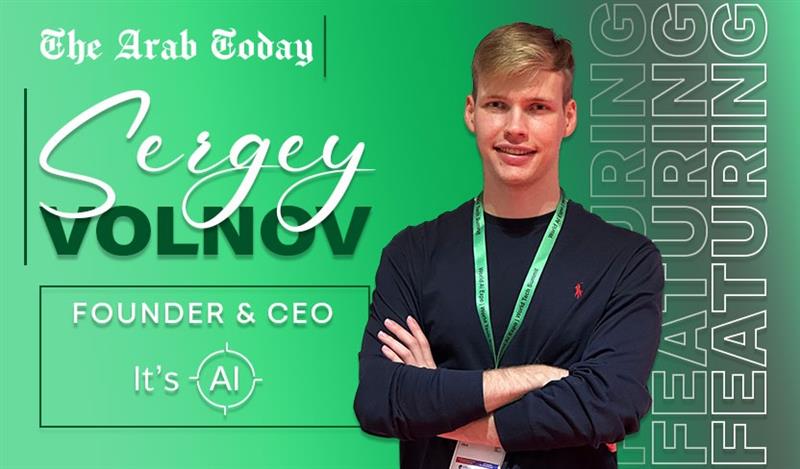
Sergey Volnov Interview
As AI-generated content becomes increasingly sophisticated, the line between human and machine-written text is rapidly blurring. In this exclusive interview with Sergey Volnov, the founder of It’s AI shares the motivation behind launching one of the world’s most accurate AI detection platforms, his journey through machine learning across industries, and a bold vision for restoring transparency, authenticity, and trust in digital communication.
From Machine Learning to a Mission of Authenticity
We started the interview by asking, “What inspired you to launch It’s AI, and why focus on AI detection?”
Sergey Volnov replied, “The idea behind It’s AI came from the growing concern I noticed while working in machine learning. As AI-generated content was getting good rapidly, but the tools to verify authenticity weren’t doing enough. As Businesses, educators, and media platforms were struggling to distinguish between human-written and AI-generated text. And I saw a clear gap in that. As for me, AI should empower people, not blur the lines of trust. That’s why I thought to build It’s AI to preserve authenticity in communication. Our mission is not to fight with AI, but to create transparency around it. As when people know what’s human written and what’s AI-generated, they can make better decisions.”
A Career Shaped by AI Applications
The Arab Today: What were you doing before founding It’s AI?
Sergey Volnov replied, “Before launching It’s AI, I worked in several ML-focused roles across different industries. I started from the banking sector, building models for churn prediction, tender recommendations, and customer classification. It was a strong foundation in applying AI to real business problems.
Later, I led ML development at Saola in Singapore, where we were building an AI-driven real estate agent capable of communicating with clients and guiding them through the sales funnel. Even earlier, I co-founded Fora vision, where we developed a real-time computer vision system for recognizing sports exercises. Each experience helped shape my technical depth and product mindset.”
Redefining Accuracy in AI Detection
The Arab Today: It’s AI is currently the most accurate AI detectors according to the MGTD benchmark. What makes your approach different?
Sergey Volnov replied, “According to me, accuracy is not just about having a strong model, it’s about understanding the problem deeply. As many AI-detectors rely on surface-level signals, which can fail when models is evolved. We focused on building systems that analyse deeper linguistic and probabilistic patterns rather than obvious indicators. Under the hood there is a whole ensemble of different models designed to recognise AI patterns with the minimum false positive rate.
We also continuously evaluate our performance against independent benchmarks like MGTD, RAID, ASAP and other academia-known datasets. And that is where we’re beating other detectors: #1 AI detector by MGTD benchmark, 98.3% accuracy on RAID, less than 0.8% FPR on ASAP. Our accuracy is not just a number on the website, it’s backed by academia benchmarks and verified by 3rd party researchers. Another key factor is iteration speed. As AI is evolving quickly, so our detection systems must evolve even faster. Our philosophy is simple: constant research, constant testing, and constant improvement.”
Preventing False Accusations
The Arab Today: How do you ensure reliability and avoid false accusations?
Sergey Volnov replied, “This is a very important question. At It’s AI, we design our system to provide probability-based assessments, where you can see not just a one number with an AI score, but also what exact sentences are likely AI-generated, which are human-written and what AI patterns the text has.
We invest heavily in reducing false positives because a wrong accusation can have serious consequences, especially in education or professional settings. Our models are trained on diverse datasets and are constantly stress-tested. We also encourage responsible usage detection tools should support decision-making, not replace human judgment.”
AI’s Impact on Education in the GCC and MENA
The Arab Today: How is AI reshaping education in the GCC and MENA region?
Sergey Volnov replied, “AI is transforming education globally, and the GCC and MENA region are no exception. Universities and schools are rapidly adopting digital tools, personalized learning systems, and AI-assisted research platforms. On one hand, AI helps students learn faster and access knowledge more efficiently. On the other hand, it creates new challenges around academic integrity and originality. In the GCC especially, where innovation agendas are strong and governments actively invest in technology, we see a proactive approach. The conversation is not about banning AI, it’s about integrating it responsibly while preserving educational standards.”
A Global Standard for Content Authenticity
Lastly we asked, “What is your long-term vision for It’s AI?”
“Our long-term vision is to become a global standard for content authenticity. As AI-generated content becomes more common, transparency will become essential across industries from education to media to corporate communication.
We want It’s AI to be not only a detection tool but a wider platform that helps people write better, stay original, and use AI responsibly. Personally, I see this as part of a larger mission: building AI systems that enhance trust rather than weaken it. Technology should strengthen human creativity, not replace it.” Sergey Volnov concluded
Connect with Sergey Volnov on LinkedIn
For more information visit It’s AI
Also Read:
Milan RAŠKOVIĆ’s Architectural Vision
Grace Lian on Building True Resilience
Jenny Konstantopoulou Redefines Excellence in Greek Realty