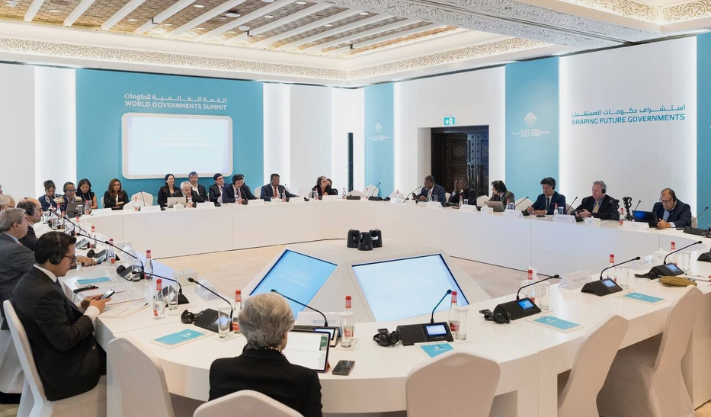
The Future of Business Strategy: Lessons on Capital, AI, and Sustainability from WGS 2026
Today, business strategy is not shaped only by market trends or customer demand. It is now strongly influenced by government policies. Governments are no longer just sharing big economic plans. They are actively setting the rules of competition.
They are deciding how artificial intelligence (AI) can be used, where data must be stored, how supply chains should be protected, and which industries will receive funding. Because of this, companies must pay close attention to government decisions.
The World Governments Summit (WGS) 2026 clearly showed this change. The event highlighted an important reality: governments are now designing the business environment. This affects startups, small businesses, and large global companies. It also affects how companies invest money, follow regulations, and plan for long-term growth.
Here are some key lessons for businesses in 2026.
Technology and AI Are Strategic Priorities
Technology and AI were major topics at WGS 2026. In past years, discussions focused on the opportunities created by AI. This year, the focus shifted toward building strong AI infrastructure.
At a panel titled “Is Technology the New Sovereign Asset?”, IBM Chairman and CEO Arvind Krishna described technology as a “force multiplier.” He said it is now as important as defense and finance.
Governments are treating AI as a national strategic asset. This includes data centers, access to computing power, skilled workers, and clear regulations. Countries are working to improve their “AI readiness.” This means building strong institutions, setting governance standards, and using AI widely in public services and important industries.
For multinational companies, this creates new challenges. Rules about data storage, algorithm transparency, and sovereign cloud services are becoming stricter. Companies must consider these rules when entering new markets.
For startups and small and medium-sized enterprises (SMEs), the situation brings both challenges and opportunities. On one hand, data and AI regulations are becoming stricter. On the other hand, governments are offering more funding and public contracts for AI projects that support national goals.
Antonio Zappulla, CEO of Thomson Reuters Foundation, emphasized that companies must focus on data governance, transparency, and responsible AI. These practices are essential for achieving long-term and sustainable returns on investment.
Smart Trade Diplomacy and Supply Chain Resilience
Global trade is changing quickly. The World Trade Organization (WTO) has noted a major shift in trade patterns, partly due to tensions between the United States and China. These disruptions are creating new opportunities for emerging markets.
At the same time, a DP World report shows that 78% of global companies are reconsidering how they operate. Many businesses are diversifying their partners to reduce risks related to tariffs, sanctions, and supply chain problems.
WGS 2026 introduced the concept of “Smart Trade Diplomacy.” This approach combines trade policy, infrastructure, digital systems, and green logistics. Its goal is to build stronger and more flexible trade systems in a world with multiple power centers. The idea was presented in a report prepared by WGS and PwC.
Because of geopolitical tensions and trade disruptions, many companies are moving production closer to their main markets. They are also choosing to work more closely with politically stable or strategically aligned countries. This helps ensure supply chain reliability.
What started as a cautious move has become a common strategy. Companies now understand the risks of long and complex global supply chains. Businesses must regularly review their suppliers, reduce their risks, and invest in secure and reliable partnerships.
In today’s world, flexibility and resilience are more important than ever.
The Realignment of Capital
Another important message from WGS 2026 was that governments are guiding investment into priority sectors. Innovation ecosystems are no longer developing by chance. They are being shaped by public policy.
For example, the AI Readiness Tool, developed with Bain & Company, helps governments measure their AI capabilities and identify steps for responsible AI development. This shows a shift from small experiments to organized, system-wide implementation.
Capital is also being redirected. Public and private investments are flowing into areas such as AI, clean energy, healthcare, logistics, and advanced manufacturing.
Several major initiatives were highlighted at the summit. These include a $1 billion “AI for Development” fund in Africa and the $2 billion Abu Dhabi Global Water Platform. These programs combine government strategy with private investment to support large-scale infrastructure and development projects.
For businesses, this means aligning with government priorities can be a smart strategy. Instead of working separately from public policy, companies may benefit from working alongside it.
Investors are now interested in strong, sector-focused solutions that support national goals. Startups and SMEs should build their strategies within these frameworks. They should include regulatory compliance from the beginning and focus on stable, long-term revenue instead of fast but risky growth.
Companies should also view governments as partners. Regulatory sandboxes, blended finance programs, and sector-focused funds provide structured ways to collaborate. Engaging early with government agencies, joining pilot programs, and participating in public-private initiatives can help businesses grow faster.
Understanding policy is now a competitive advantage. Companies that understand regulations and national strategies can secure long-term contracts, expand internationally, and gain institutional support.
Sustainability Remains a Core Priority
Sustainability was another major focus at WGS 2026. It was not treated as a side topic but as an economic priority.
Speakers highlighted national plans to achieve net-zero emissions and expand clean energy. For example, the Dubai Electricity and Water Authority (DEWA) confirmed the UAE’s goal of reaching 100% clean energy generation capacity by 2050.
The summit also showed how sustainability is linked to investment and development projects. The Abu Dhabi Fund for Development (ADFD) signed agreements to support the Rogun Hydroelectric Power Station in Tajikistan. This project aims to improve energy security, water stability, and long-term infrastructure in Central Asia.
Although some major economies, including the United States, have slowed certain international climate commitments, WGS 2026 made it clear that many governments continue to prioritize climate action. In many regions, sustainability remains a key driver of investment decisions and infrastructure planning.
For businesses, this means sustainability is not optional. Companies that adopt low-carbon strategies, invest in clean energy, and plan for climate resilience will have better access to funding. They will also be better prepared to participate in international projects and meet government expectations.
A New Business Reality
Overall, WGS 2026 showed that the relationship between governments and businesses is changing. Governments are no longer passive regulators. They are active designers of economic systems.
This new reality requires companies to think differently. They must monitor policy changes, build compliance into their strategies, and align with national priorities.
Technology, trade, capital investment, and sustainability are now strongly connected to government strategy. Businesses that understand this shift and adapt quickly will be better positioned for long-term success.
In 2026 and beyond, success is not only about market demand. It is also about understanding policy, building resilience, and working within a government-shaped economic system.
The future of business strategy belongs to companies that can balance innovation with regulation, growth with responsibility, and global ambition with national alignment.
Published: 12th February 2026
For more article like this please follow our social media Twitter, Linkedin & Instagram
Also Read:
Gulf Capital’s Big Bet: Sovereign wealth in global economy
The Middle East at the Center of a Sanctions-Driven Energy Market
Oman’s Investment Drive Marks a New Stage in Gulf Competition