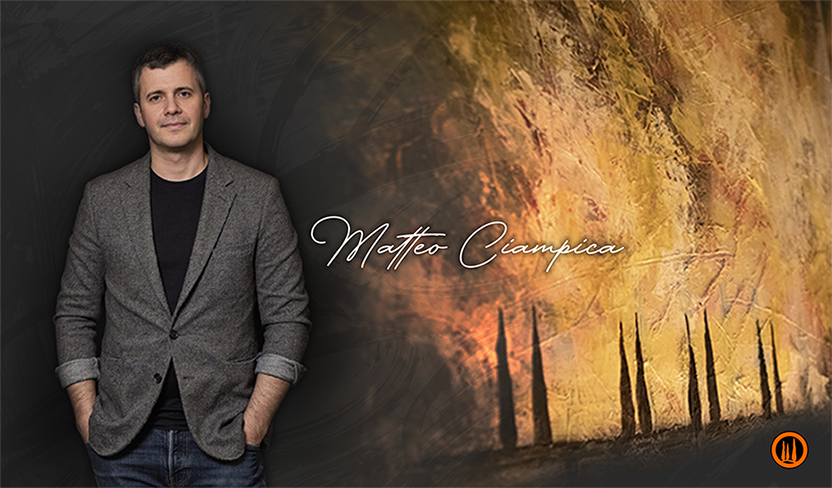
Matteo Ciampica
The investigation into the nature of the temporal dimension constitutes the core of Matteo Ciampica’s poetic inquiry, situating itself within an analytical trajectory already traced by figures such as Anselm Kiefer, Christian Boltanski, On Kawara, and Roman Opalka. Each of these artists has developed a distinct visual and conceptual language to probe the multiple facets of this category, dissecting notions such as duration, instant, memory, oblivion, experience, stratification, and infinity.
If modern art, with Marcel Duchamp, had primarily focused on the visual translation of movement and chronophotographic dynamism, contemporary art radicalizes this tension by transforming time into matter in Kiefer’s pictorial stratifications, but also into collective memory in Boltanski’s installations, into obsessive daily measurement in the works of On Kawara, into political urgency in the practice of Alfredo Jaar, and into the fragility of existence in the gestures of Felix Gonzalez-Torres.
Within this constellation, numerous artists offer specific declinations of the temporal dimension, opening a space of dialogue with Ciampica’s research, which shifts the focus from the analysis of time as a datum toward its social dimension, understood as gift and as testimony.
In Ciampica’s work, reflection transcends the dichotomy between objective measurement and subjective perception, arriving at an ethical-anthropological dimension of time. Through a dense network of categories ranging from stratification to entropy, and from cyclicality to oblivion, the artist articulates time along three fundamental axes:
⦁ Kairos: the opportune instant, conceived as a trigger of awareness against contemporary frenzy.
⦁ Matter and Memory: a stratification that, in dialogue with Kiefer and Boltanski, configures itself as testimony of being-there (Dasein).
⦁ Social Restitution: time understood as gift, expressed through the poetics of the errant works and the symbolism of cypresses, totemic presences that fix permanence without rigidifying it.
Ciampica’s work thus takes shape as an act of restitution to humanity: a subtraction from entropic disorder in order to return to human beings the possibility of dwelling poetically the world through a time of quality, reflective and profoundly relational.
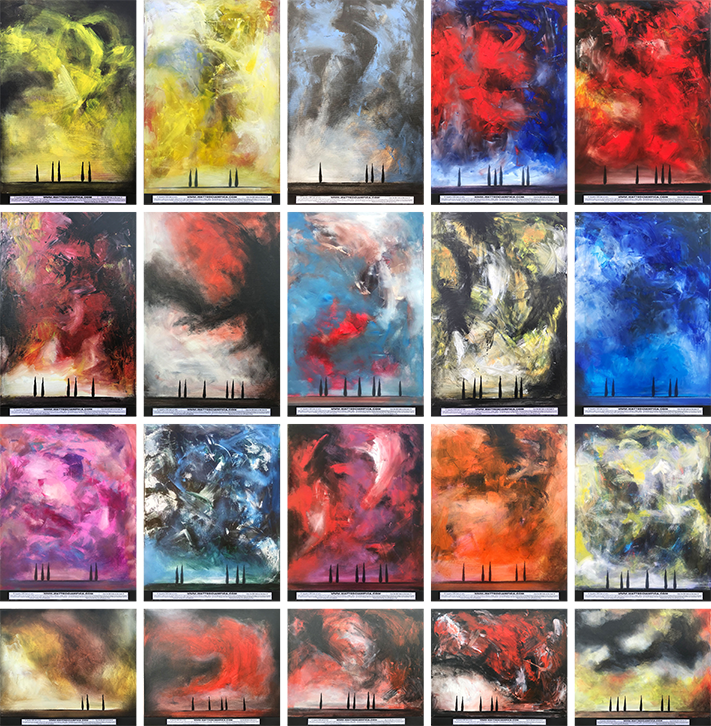
These are the Artworks that participate in the ‘Kairos Interaction’
These Artworks, at this moment, are traveling freely around the world
www.matteociampica.com/interazioni_dett.php?name=VVS4V59
The temporal architecture of Ciampica’s research unfolds along two complementary axes: Verticality, understood as a recursive gesture that evokes infinity and ontological persistence, and Horizontality, which does not measure duration but rather explores its relational quality. In his practice, the ritual repetition of the gesture is not mere iteration, but an act of extreme creative intentionality, through which the artist transforms an obsession with the same subjects into a device capable of generating striking aesthetic differences, infinitely variable configurations that render each work irreducibly unique. Within them, each viewer may grasp those traits in which to recognize themselves, that window of quiet and reflection that resonates with one’s own being, and with it alone enters into dialogue.
Through universal symbols such as the sky, cypresses, and the terrestrial line, Ciampica performs a reconfiguration of time, shifting it from the chronological dimension to that of kairos, the opportune instant, the salvific occasion. His is a poetics of restitution that, originating from an intimate and personal artistic inquiry, is transfigured into a collective gift. His cypresses, conceived as living monuments that remember without oppressing, and his errant works celebrate an art that is testimony and resistance, capable of elevating reflection on time into an act of collective regeneration, while establishing a dense dialogue of intuitions and processes with the great contemporary masters.
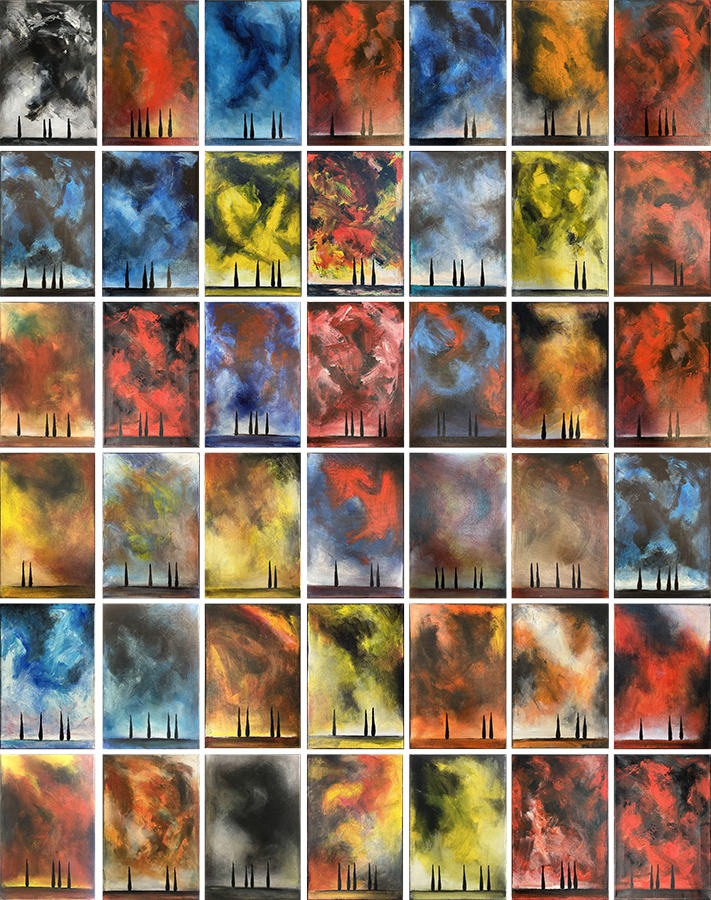
Other Artworks participating in the “Kairos Interaction”
These Artworks, at this moment, are traveling freely around the world
www.matteociampica.com/viains.php
www.facebook.com/profile.php?id=61568249155110
A particularly compelling comparison emerges with On Kawara (1932–2014), the Japanese artist who made the registration of time the foundational nucleus of his poetics. A comparative analysis between Kawara and Ciampica reveals a profound elective affinity grounded in minimalist reduction and the rituality of gesture, even though the two artists articulate temporal ontology along divergent vectors. While Kawara elevates time to an impersonal and statistical datum, Ciampica transfigures it into an ethical and relational occasion.
The difference lies in the very nature of the time under investigation: through the Date Paintings and the telegrams of I Am Still Alive, Kawara acts as an archivist of existence. His is a sequential and inexorable time, and the artwork functions as a monastic registration that transforms the banal into the monumental through narrative subtraction. Kawara registers the flow, Ciampica interrogates it. His recursive extractions are not mere chronological data, but sparks of opportunity. Time is not simply endured or recorded, but poetically inhabited and restituted to the community as a space of freedom.
Despite the distance between Kawara’s registration and Ciampica’s invitation, the two masters share radical methodological pillars:
⦁ Work–Process Identity: for both, the individual realization is subordinate to an exhausting and vital practice. The value of the work resides in its becoming testimony of a constant presence in the world.
⦁ Aesthetic Subtraction: the renunciation of commentary and complex narrative allows ‘dates’ (Kawara) and ‘cypresses’ (Ciampica) to rise as universal symbols. The simplicity of the sign becomes the necessary vehicle for a research that aspires to the absolute.
⦁ Resistance to Oblivion: both challenge the incommensurability of time through the measure of the gesture. If Kawara declares I am still alive as a reminder of finitude, Ciampica responds live consciously, transforming temporal limitation into an act of collective regeneration.
If Kawara strips time of its invisibility, turning it into a chronological monument, Ciampica redeems its quality by turning it into an ethical monument. Ciampica’s errant works and Kawara’s telegrams represent two sides of the same coin: research as the sole truth, and art as an extreme act of resistance and gift to humanity.
The figure of Christian Boltanski (1944–2021) also enters these reflections with equal force. In contemporary art, few artists have interrogated collective memory and the sense of human presence in time with comparable intensity. His installations are fragile monuments to the precariousness of existence, secular altars of memory and mourning. Photographs, garments, flickering lights, and anonymous faces express his obsession with the necessity of preserving memory against universal perishability.
With Boltanski and Ciampica, a fascinating dialogue emerges between two different modes of resistance to oblivion, in which artistic practice becomes both an archiving of existence and an ethical imperative. Although both artists engage in a struggle against disappearance, their aesthetic postures occupy opposite poles of the same ontological tension. In Boltanski one may speak of an Elegy of Absence, in which time appears as a wound, a cemetery of memory. Through installations of used clothing, anonymous photographs, and dim lights, Boltanski erects secular altars to mourning. His is a small memory that celebrates the absent body, where archival accumulation serves to testify to what has irreversibly vanished.
In Ciampica, by contrast, the concept of a regeneration of kairos is reaffirmed, in which time becomes a garden of possibilities perpetually reactivatable. Where Boltanski accumulates traces of loss, Ciampica enacts a generative dispersion (the errant works). His sacredness of presence employs the cypress-witness as a sign of immanent inviolability, transforming memory from static relic into relational flow.
Both artists transfigure private experience into collective monument through the radical depersonalization of the self. Just as Boltanski’s portraits lose anagraphic identity to become mirrors of humanity, Ciampica’s cypresses renounce names in order to incarnate the being-there of anyone. The absence of the authorial ego allows the totality of humanity to enter the work.
For both, artistic action constitutes a challenge to the impossible. Boltanski attempts to save memory while knowing it is destined to disappear; Ciampica paints to the point of exhaustion in order to immortalize every configuration of kairos, acting as though victory over oblivion were possible.
The core of both poetics lies in the role of the Viewer, called upon to complete the work with their own lived experience. In Boltanski, the spectator becomes a witness of mourning, recognizing their own finitude in the empty garment. In Ciampica, the viewer becomes part of a collective interaction: the work functions as a trigger that requires active recognition in order to return to existence. If Boltanski’s work is a secular liturgy of lack, Ciampica’s is an explicit testimony of possibility. Yet both converge on the idea that remembering is not preserving, but bringing an experience back to the heart and into the present, transforming time from ineluctable destiny into ethical and conscious task.
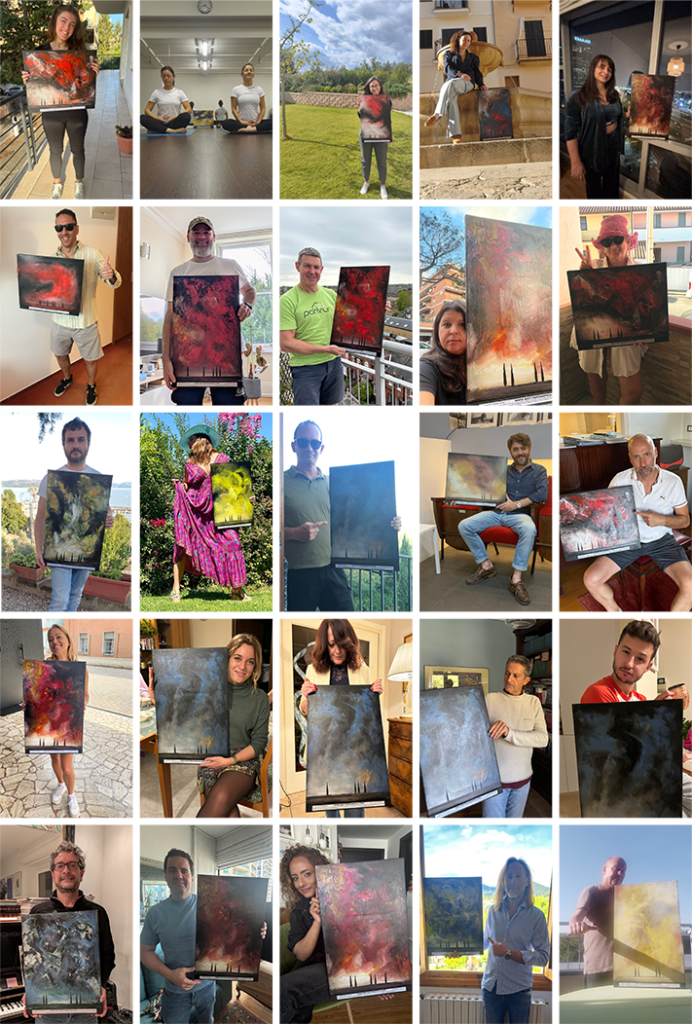
Viewer-Witnesses of Ciampica’s Interactions
www.matteociampica.com/interaction.php
Ultimately, among the three artists one may posit a methodological convergence in the concept of the work as organism in becoming as an aesthetic response to the crisis of temporal perception in the twenty-first century. By dismantling the classical ideal of the definitive artifact, all three adopt the open form and work-in-progress not as stylistic choices, but as strategies for the survival of meaning. The artwork is not an object, but a process immanent to time.
Ciampica’s Aphonia cycle constitutes a serial corpus in which meaning resides in summation and organic growth. Each new configuration expands the thickness of the present, opposing duration to the hyper-accelerated fragmentation of contemporaneity. The seriality of Aphonia is not repetition but differential variation: each painting retroactively modifies the sense of the entire corpus, declaring reality to be constitutively incomplete. This incompleteness becomes a value: the work must continue because the real continues to generate possibilities.
In Boltanski, the archive is a living organism that grows through accumulation, attempting to compensate for the entropy of historical memory through a monumental compression of lived experience. In Kawara, the Date Paintings series constitutes a monastic exercise of registration, time becomes matter through the ritualization of the present, neutralizing the indistinct flow of data with the elementary attestation of being-there. In an era of absolute presentism and digital flows that annihilate historical experience, the art of these three masters functions as a device for the reconfiguration of the Λόγος (Logos). Wanting to provide an extreme synthesis of the specificities of the artists examined, the following scheme is proposed:
Kawara Loss of consistency of the present Ritualization Saving presence.
Boltanski Loss of historical memory Reactivation Saving the lived.
Ciampica Loss of durability and depth Expansion Save the possible.
The legacy of this three-voiced dialogue lies in the transformation of art into a discipline of time. By refusing closure, the work becomes a performative act and a ritual fidelity. It is no longer merely a matter of resisting oblivion, but of anchoring oneself to time without being subjected to it, transforming the temporal dimension into a sacred and inviolable space, withdrawn from the rapid consumption of meaning.
Dott.ssa Cinzia Cardinali
2024.05.02
Connect with Matteo Ciampica on Facebook
For more information visit Matteo Ciampica’s website
Published: 26th February 2026
For more article like this please follow our social media Twitter, Linkedin & Instagram
Also Read:
Time as Ontology in the Research of Matteo Ciampica
Matteo Ciampica: Contemporary Art through Time
GCC real estate grows in H1 2026, beyond oil focus