How Saudi Capital Could Reshape Syria’s Return to Regional Markets
For many years, Syria’s return to the Arab world was mostly about politics and diplomacy. Meetings were held, statements were made, and relations slowly improved. But now, money is becoming more important than politics. Saudi companies have signed multibillion-dollar investment deals with Syria, showing a clear shift from political normalisation to real economic cooperation. Saudi capital is now playing a major role in shaping Syria’s future after years of isolation.
For the Syrian government, investment from Gulf countries is not only about rebuilding damaged cities. It is also about bringing Syria back into regional markets and restoring its economic importance. Rebuilding infrastructure such as airports, telecom networks, and water systems is essential to restart business activity and improve government services.
For Saudi Arabia, investing in Syria is part of a larger strategy. Riyadh believes that a stable Syria is important for regional security, trade connections, and long-term economic growth in the Middle East.
A Shift Toward Economic Reintegration
Over the past decade, most contact with Syria was limited to diplomacy. Countries discussed political solutions, but there was little real economic engagement. That is now changing.
Saudi Arabia is using investment as its main tool to help Syria reintegrate into the region. Instead of focusing only on political recognition, Riyadh is putting money into key sectors of the Syrian economy. This approach connects Syria’s future stability directly to regional economic growth.
Azad Zangana, Head of GCC Economic Analysis at Oxford Economics, said Gulf countries are working seriously to bring Syria back into the regional system. After the fall of Bashar al-Assad’s government, the focus shifted to restoring security, rebuilding infrastructure, and reducing regional political risk.
He explained that billions of dollars in aid and investment are now coming from regional partners, especially Saudi Arabia and the UAE. Over time, Syria could regain access to global financial systems and restart energy production and exports.
Major Investment Agreements
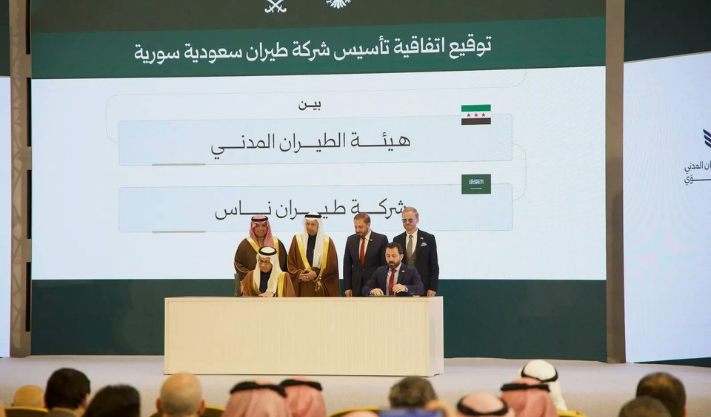
Recently, Saudi companies and Syrian government entities signed multibillion-dollar agreements in Damascus to help revive the Syrian economy.
One major project is the launch of the Elaf Investment Fund. Saudi Arabia committed $2 billion (SAR 7.5 billion) to redevelop and operate two airports in Aleppo. The project will happen in different phases and aims to modernize airport services and increase connectivity. The fund will also finance other large projects in Syria with the participation of Saudi firms.
In the aviation sector, Saudi low-cost airline flynas signed an agreement with the Syrian Civil Aviation Authority to create a new airline called flynas Syria. The Syrian authority will own 51% of the company, while flynas will own 49%. The airline is expected to start operations in late 2026.
Telecommunications is another key area. Saudi Telecom Company (STC) will invest $800 million (SAR 3 billion) under a project called Silk Link. This project will build a fiber-optic network of more than 4,500 kilometers across Syria, improving internet service and connecting the country to regional and international networks.
In addition, Saudi companies ACWA Power and National Water Transmission signed an agreement with Syria’s Ministry of Energy to develop a water desalination and transport project. Water supply is a serious issue in many parts of Syria, and this project aims to improve access and reliability.
There was also a new real estate development deal signed under the Saudi-Syrian Business Council, which was officially launched during the visit. This council aims to increase cooperation between private sector companies in both countries.
Saudi Arabia as an Economic Anchor
These investments follow a broader strategy by Saudi Arabia to support Syria’s return to both regional and global markets. Riyadh has supported President Ahmed Al-Sharaa since he came to power in 2024 after Bashar al-Assad was removed.
Saudi Arabia has also worked diplomatically to push for easing Western sanctions on Syria. In discussions with Washington and European governments, Saudi officials encouraged changes in legal restrictions that had blocked Syria from international finance.
In July 2025, a Saudi-Syrian investment forum in Damascus led to around $6.4 billion in agreements across infrastructure, communications, and manufacturing. The deals involved 100 Saudi companies across 47 agreements.
Earlier, in April 2025, Saudi Arabia and Qatar paid around $15 million in Syrian debt to the World Bank. This step removed an important obstacle to Syria’s return to international financial institutions. As a result, the World Bank resumed operations in Syria, allowing the country to apply for new loans and grants for reconstruction.
Together, these moves show that Saudi Arabia is not only offering political support but is becoming one of the main economic partners in Syria’s recovery.
Why Syria Is Important for Saudi Strategy
Saudi Arabia’s engagement with Syria is about more than business. It is also about regional stability. After more than ten years of war, Syria remains a source of political and security risks in the Middle East.
If Syria’s economy collapses again, it could lead to extremism, cross-border crime, and social unrest. This would affect neighboring countries and the wider Arab region. By investing in Syria, Saudi Arabia hopes to reduce these risks.
In this way, Saudi capital is not just commercial investment. It is also a tool for stability. Rebuilding infrastructure and creating jobs can help reduce the conditions that often lead to conflict.
At the same time, Saudi companies see strong business opportunities. Syria needs rebuilding in aviation, telecommunications, energy, logistics, and real estate. Companies that enter the market early may benefit from long-term growth as reconstruction continues.
Challenges and Risks Ahead
Despite growing optimism, Syria’s recovery still faces many challenges. Government institutions are still being rebuilt. Legal and regulatory systems are not yet fully developed. Political risk remains a concern for many investors.
Although some sanctions have been lifted or eased, others remain in place. Future changes in US or European policies could create uncertainty. Investors are watching closely to see if the regulatory environment becomes more stable and predictable.
Syria also remains influenced by other regional and international powers, including Iran, Türkiye, and Russia. While Saudi Arabia wants Syria to return fully to the Arab economic sphere, these other actors still have strong influence. The balance between these powers will shape Syria’s political independence and its business environment.
A New Economic Model for the Region
Saudi Arabia’s investment-led approach shows that Syria’s return is no longer just a political idea. It is now an economic project.
If these projects succeed, Syria could once again become a regional transit hub connecting Gulf investment with markets in the Levant and trade routes across the Mediterranean. Improved airports, telecom networks, and logistics systems could help Syria regain its strategic location in regional trade.
More broadly, this reflects a change in how Gulf countries use their influence. Instead of focusing only on diplomacy or aid, they are using long-term investments to shape political and economic outcomes.
The Saudi-Syrian deals are therefore not only about rebuilding one country. They represent a new way of using economic power to shape the post-conflict Middle East. Whether this strategy succeeds will depend on political stability, consistent reforms, and continued regional cooperation.
But one thing is clear: Saudi capital is now one of the most important forces shaping Syria’s path back into regional markets.
Published: 13th February 2026
For more article like this please follow our social media Twitter, Linkedin & Instagram
Also Read:
Top Winners Among the Richest Arab Families 2026
Insights on Capital AI and Sustainability at WGS 2026 Meeting
Gulf Capital’s Big Bet: Sovereign wealth in global economy